
Asphalt Shingle Roofing Montgomery
Asphalt shingles cover more Montgomery homes than any other residential roofing material — but the category is broader than most homeowners realize. Between three-tab, architectural, designer, and impact-rated products, shingle roofing involves a range of styles, performance characteristics, and compatible roof-system components. This page explains the category and what shapes a sound shingle roof, separately from the architectural installation focus on its own page.
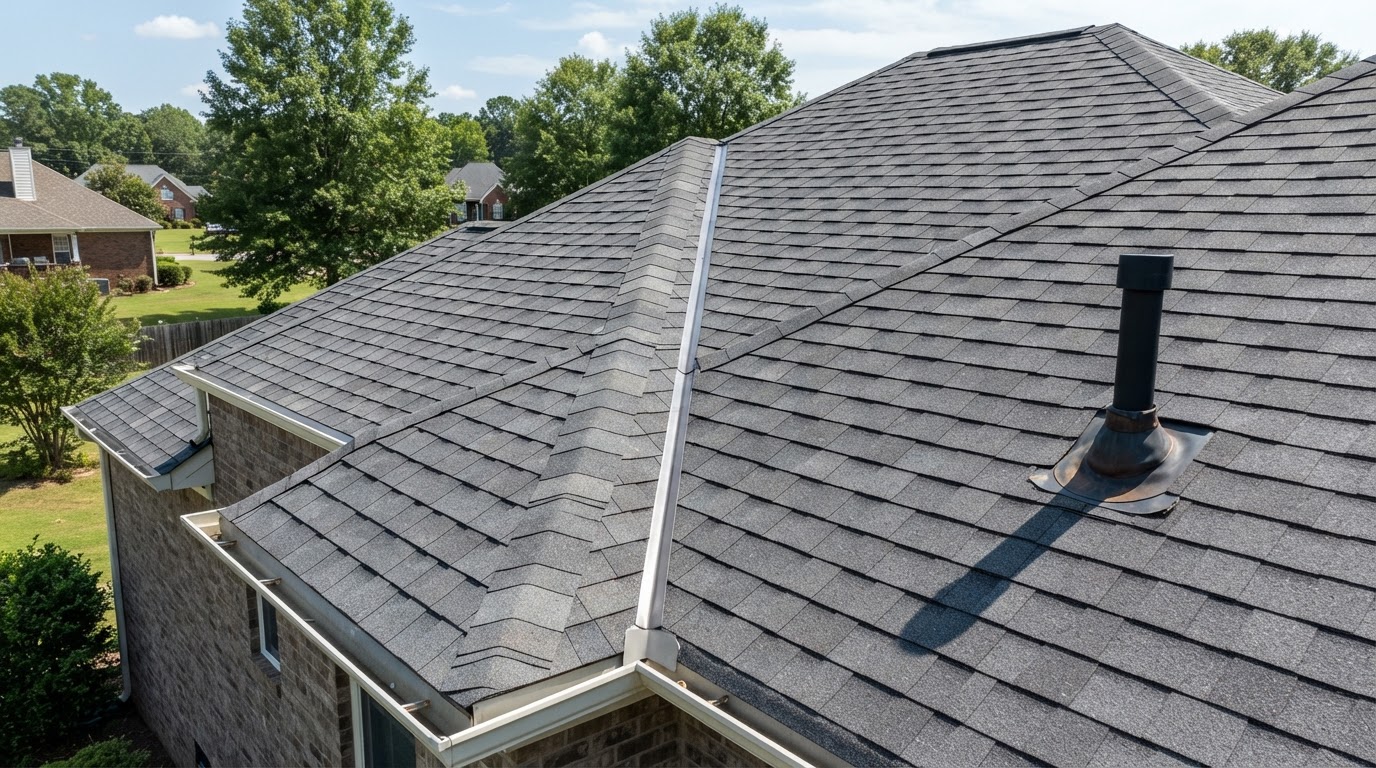
Types of Roof Shingles for Montgomery Homes
Traditional Three-Tab Shingles
Single-layer strip shingles with a flat, uniform appearance and cut-out tabs that create a repeating pattern. The lightest and most economical asphalt option, suitable for straightforward roof planes with appropriate slope.
Architectural Shingles
Laminated construction with two or more layers bonded together, producing a thicker, dimensional appearance. The most common replacement choice on modern Montgomery homes. See the architectural shingle installation page for installation-specific planning.
Architectural Shingle InstallationDesigner and Specialty Shingles
Premium product lines with distinct profiles, colors, or simulated materials. Differences are product-specific — this page does not claim any manufacturer partnership or certification.
Impact-Resistant Shingles
Products tested and classified for impact resistance (such as Class 4 where a specific product earns that rating). Impact classifications apply to specific tested products and systems — not every architectural shingle is Class 4, and no asphalt shingle is hail-proof.
What Matters When Planning Shingle Roofing Near Montgomery?
A shingle is only one part of a roof. The covering, the barrier beneath it, the flashing at every transition, and the ventilation above the insulation all work together. Planning a shingle roof means planning the system, not just selecting a product.
Roof slope
Shingle type, underlayment, and installation method all depend on pitch — steep and low-slope roofs behave differently.
Existing covering
What is currently installed, how many layers, and whether a tear-off is required or an overlay is even possible.
Decking condition
The structural deck the shingles fasten to — sound, dry, and properly spaced substrate matters.
Ventilation
Balanced intake and exhaust ventilation affects shingle temperature and attic moisture over time.
Underlayment
The water-shedding barrier beneath the shingles, selected for slope, code, and product requirements.
Flashing
Step, apron, valley, drip-edge, and penetration flashing that direct water away from vulnerable joints.
Roof penetrations
Vents, skylights, and chimneys that interrupt the shingle field and require coordinated flashing.
Product compatibility
Matching starter strips, ridge caps, and accessories to the chosen shingle system.
This page describes considerations, not a universal installation specification. Actual underlayment, fastening, and slope requirements follow the selected product, the roof assembly, applicable code, and manufacturer instructions.
Understanding Asphalt Shingle Roof Systems in Montgomery
A shingle roof is an assembly. The field shingles cover the main roof planes, but starter strips seal the bottom edge, underlayment and leak barriers protect the deck, drip edge controls water at the perimeter, and hip and ridge caps close the peaks. Flashing at every transition — valleys, walls, chimneys, and penetrations — ties the covering to the rest of the building.
Ventilation components work in the opposite direction from the shingles: they manage the attic environment so heat and moisture don't shorten the roof's serviceable life. Roof decking is the substrate everything fastens to, and its condition determines whether the assembly above it can perform.
Choosing Shingle Colors and Styles for Montgomery Homes
A shingle color sits alongside siding, brick, trim, and the home's architectural style for decades. Lighter shingles can read cooler; darker shingles hide streaking but absorb more heat. Profile and color choices are easiest to weigh against an actual product sample and the home's exterior, not a screen.
Asphalt Shingles vs. Metal Roofing
Asphalt and metal differ in material, installation approach, maintenance, and appearance. Shingles are the more common and economical residential choice; standing seam metal offers a different look, fastener exposure, and maintenance profile. Neither is universally better — the comparison depends on roof geometry, maintenance preference, and project scope. This page does not assign unsupported lifespans or cost guarantees to either material.
Asphalt Shingle Roofing Questions for Montgomery Homes
What types of asphalt shingles are available?
Common residential options include three-tab strip shingles, laminated architectural shingles, designer and specialty product lines, and impact-rated shingles where a specific product earns a rating. Each has a different appearance, weight, wind rating, and profile.
How are three-tab and architectural shingles different?
Three-tab shingles are single-layer strips with a flat, uniform look. Architectural shingles are laminated, with two or more layers bonded together for a thicker, dimensional appearance. They differ in construction, weight, and profile — and in how they show wear over time.
What affects asphalt shingle roof performance?
Product selection, installation quality, underlayment, flashing, ventilation, and roof slope all contribute. A shingle roof is a system, and the weakest component often governs overall performance. Climate exposure — heat, storm-driven rain, and ventilation — also plays a role.
Can damaged asphalt shingles be repaired?
Yes, when the damage is localized and the surrounding shingles are sound. Individual or small groups of shingles can be replaced, and flashing or penetration components can be repaired without a full replacement — provided the rest of the assembly is serviceable.
How important are flashing and underlayment?
Critical. Shingles shed water across the field, but the joints — valleys, roof-to-wall transitions, chimneys, penetrations — depend on flashing, and the deck depends on underlayment. A sound shingle over failed flashing or saturated underlayment still leaks.
Are all architectural shingles impact-resistant?
No. Impact resistance is a tested classification (such as Class 4) earned by specific products, not a feature of every architectural shingle. No asphalt shingle is hail-proof or tornado-proof. Impact ratings are product-specific and require verification for the exact product.
What should I consider when choosing a shingle color?
Compatibility with the home's siding, brick, trim, and architectural style; how the color reads in Central Alabama sunlight; and the long trade-off between lighter shingles that stay cooler and darker shingles that hide streaking. A physical sample against the exterior is the most reliable way to choose.
Considering Asphalt Shingle Roofing Near Montgomery?
Share the roof material, the property type, the roof's general condition, and what prompted the question — a planned replacement, a repair, or material research. The right shingle choice follows the roof's slope, ventilation, and the compatible system components, not a product name alone.