
Exposed-Fastener Metal Roofing Montgomery
Exposed-fastener metal roofing is defined by one feature: the screws pass through the face of the panel into the substrate or framing beneath. That visible fastener pattern is the signature of 5V-crimp and R-Panel roofs, and it shapes both the appearance and the maintenance the roof needs over time. This page covers through-fastened systems specifically — not standing seam, where the fasteners are concealed — and the 5V and R-Panel profiles homeowners in Montgomery most often encounter.
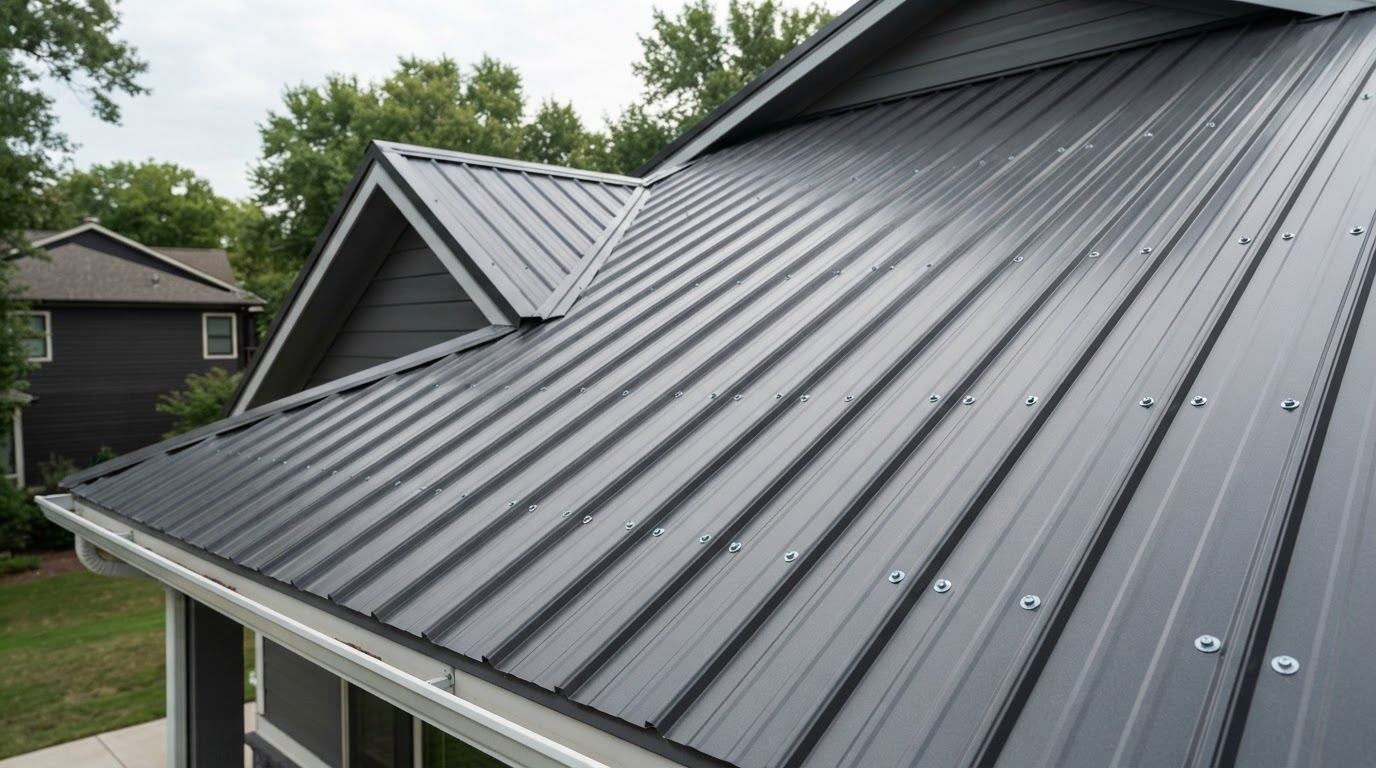
5V-Crimp & R-Panel Metal Roofing Near Montgomery
5V-Crimp Metal Roofing
A traditional V-crimp profile with a relatively shallow rib and a repeating crimped appearance. Common in residential and agricultural applications, with visible fasteners at specified intervals. Substrate and slope requirements are product-specific — the panel attaches to solid sheathing or properly spaced framing per the manufacturer, and trim and flashing follow the profile.
R-Panel Metal Roofing
A raised-rib profile with deeper major ribs, originally developed for post-frame and metal-building applications and used on some residential roofs. Visible fasteners with sealing washers attach the panel to the supporting structure. Panel dimensions and configurations vary by product, and suitability depends on the roof, the structure, and the manufacturer's requirements — not every R-Panel suits every residential roof.
5V and R-Panel are different profiles, not the same product. They differ in rib configuration, panel dimensions, the structural support they require, and the applications they suit. This page treats them as distinct rather than interchangeable.
Exposed-Fastener Metal Roof Installation Considerations in Montgomery
Panel selection
Profile, width, gauge, and finish chosen for the roof and the application.
Supporting structure
Solid sheathing or spaced framing as required by the panel and the manufacturer.
Decking or framing
The substrate the screws engage; its condition and spacing matter to the assembly.
Fastener compatibility
Screws matched to the panel and substrate for weathering and hold.
Sealing washers
Washers that seal the fastener penetrations, sized and installed per the product.
Fastener placement
Screw location in the flat or rib per the manufacturer's instructions — not a universal pattern.
Thermal movement
Panels move with expansion and contraction; oversized holes or laps may be required.
Panel laps
End and side laps that follow the panel instructions for sealing and overlap.
Flashing
Valley, wall, eave, and rake flashing coordinated with the panel.
Roof penetrations
Vents and other penetrations flashed in coordination with the panel ribs.
Ridge and edge components
Ridge caps, eave trim, and closure strips that finish the system.
Corrosion considerations
Material, finish, and environment (including dissimilar-metal contact) factored into selection.
This page does not prescribe a universal fastener spacing or torque. Screw location, spacing, and sealing follow the specific panel, the roof assembly, applicable code, and the manufacturer's installation instructions.
Exposed-Fastener Metal Roof Maintenance Near Montgomery
Because the fasteners pass through the panel face, exposed-fastener roofs receive maintenance attention that concealed-fastener systems do not. Washers age, fasteners can back out with thermal movement, and sealants at laps and penetrations can weather. Periodic review is what keeps a through-fastened roof performing.
Worth reviewing over time: fastener condition, washer seal, panel movement, sealants where applicable, flashing, penetrations, signs of corrosion, panel damage, and drainage. No metal roof is maintenance-free, and exposed-fastener systems carry a particular maintenance profile because of the visible fasteners.
Exposed-Fastener vs. Standing Seam Metal Roofing
The difference is attachment. Exposed-fastener panels are through-fastened with visible screws and washers; standing seam conceals the fasteners beneath raised seams. Exposed-fastener costs less upfront and needs ongoing fastener and washer review; standing seam carries a cleaner roof plane and different maintenance attention. Neither is universally better.
What Affects the Cost of 5V and R-Panel Roofing?
Cost reflects roof area and complexity, the panel profile and material, flashings and fastening details, removal requirements, the supporting structure, and access. This page does not publish installed price ranges — scope and cost are established through an inquiry and assessment.
Exposed-Fastener Metal Roofing Questions for Montgomery Homes
What is exposed-fastener metal roofing?
A through-fastened panel system where screws pass through the face of the panel into the substrate or framing beneath. The fasteners are visible on the weathering face, typically with sealing washers. 5V-crimp and R-Panel are common profiles.
What is the difference between 5V-crimp and R-Panel?
5V-crimp is a traditional V-crimp profile with a relatively shallow rib. R-Panel carries deeper major ribs and was developed for post-frame and metal-building applications. They differ in rib configuration, panel dimensions, structural requirements, and the applications they suit — not interchangeable products.
How is exposed-fastener metal different from standing seam?
Attachment. Exposed-fastener panels are through-fastened with visible screws and washers; standing seam conceals the fasteners beneath raised seams. The difference affects appearance, how the panel handles thermal movement, and where maintenance attention is needed over time.
Do exposed-fastener roofs require screw and washer maintenance?
Yes. Because the fasteners pass through the panel, washers age, screws can back out with thermal movement, and sealants can weather. Periodic review of fastener condition, washer seal, and sealants is appropriate — this is the maintenance profile the visible fasteners create.
Can exposed-fastener panels be used on residential roofs?
They can be, when the roof, structure, and slope suit the profile and the manufacturer's requirements are met. Suitability follows the specific product and the roof — not every exposed-fastener panel suits every residential application, and R-Panel in particular carries structural requirements.
What causes leaks around metal roof fasteners?
Common causes include aged or displaced washers, fasteners backing out from thermal movement, sealant weathering at laps and penetrations, and corrosion. Locating the actual entry point can require reviewing several components — a leak near a fastener does not always mean that fastener is the cause.
What affects exposed-fastener roofing cost?
Roof area and complexity, the panel profile and material, flashings and fastening details, removal requirements, the supporting structure, and access. This page does not publish installed price ranges; scope and cost are established through an inquiry and assessment.
Considering 5V or R-Panel Metal Roofing Near Montgomery?
Share the roof's slope, the existing material, the panel profile being considered, and the property type. The right exposed-fastener system follows the supporting structure, the panel's slope requirements, and the fastener and flashing details — not a profile name alone.