How Long Do Shingles Last in Alabama Heat and Humidity?
Alabama's heat, humidity, and storm seasons all shape how long an asphalt shingle roof performs. This guide explains what actually influences shingle service life — and why a warranty term is not the same as a guaranteed lifespan.
How Long Can Asphalt Shingles Last in Alabama?
Service life is a range shaped by many variables — not a fixed number that applies to every roof.
There is no single lifespan that applies to every asphalt shingle roof in Alabama. Actual service life depends on the particular product, the quality of its installation, the roof's design and slope, attic ventilation, the amount of sun and shade the roof receives, storm exposure, and how consistently the roof is maintained. Two roofs built with the same shingle can perform very differently because of these surrounding conditions.
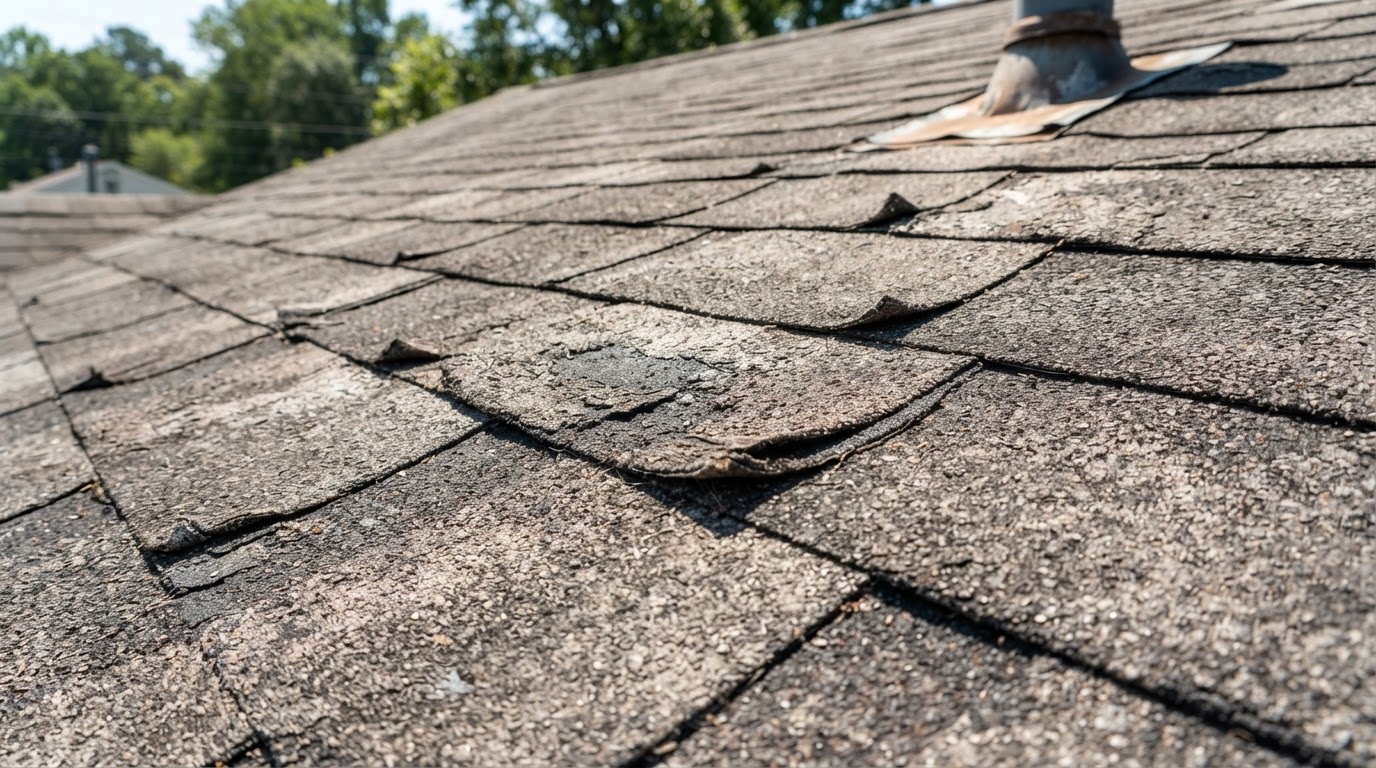
Any numerical service-life figure you encounter should be treated as a general estimate, not a guarantee. Manufacturer literature, industry resources, and installer experience can offer useful reference points, but the only reliable way to judge a specific roof is to evaluate that roof's actual condition on site — its shingle flexibility, granule retention, flashing, ventilation, and any signs of moisture or storm effects.
Warranty length is not a lifespan guarantee
How Alabama Heat and Humidity Affect Roofing
Climate is a major influence — but it works through several mechanisms, not a single one.
Alabama roofs face repeated solar exposure that can drive shingle surface temperatures well above the surrounding air. Over many heating and cooling cycles, the asphalt in a shingle expands and contracts, gradually becoming less flexible. This thermal movement is a normal part of aging, but it is accelerated by intense, sustained sun on south- and west-facing slopes.
Humidity and moisture interact with the roof assembly rather than attacking the shingle directly. When warm, humid air is trapped in a poorly ventilated attic, condensation can form on the underside of the deck, contributing to deck movement, fastener corrosion, and premature wear of roofing components. Shaded roof areas that stay damp longer may also support algae growth, which is a separate cosmetic concern. Storm exposure — wind, hail, and debris — adds another layer of stress that can shorten effective service life regardless of the shingle's calendar age.
It would be a mistake to blame humidity alone for every roofing failure. The roof's ventilation, design, product selection, and maintenance history usually matter more than the climate by itself.
Architectural Versus Three-Tab Shingles
Two common shingle types differ in construction and characteristics — but neither is universally superior.
| Factor | Architectural (Laminated) | Three-Tab |
|---|---|---|
| Construction | Laminated multi-layer mat with a thicker, dimensional profile | Single-layer strip shingle with a flat, uniform appearance |
| Wind resistance | Often rated for higher wind speeds per manufacturer specs | Typically rated for lower wind speeds than architectural |
| Aesthetics | Deeper shadow lines and a textured look | Flatter, more uniform finish |
| Maintenance | Similar upkeep needs; tabs resist lifting somewhat better | Individual tabs can be replaced if damaged |
| Application | Common on most modern residential replacements | Often used on budget projects or outbuildings |
These are general differences. Specific wind ratings, warranty terms, and performance vary by manufacturer and product line — always review the actual product documentation rather than assuming a category-wide standard.
Signs a Shingle Roof May Need Evaluation
Watch for conditions that warrant a closer, on-site look.
Some of these signs reflect age-related wear, while others can point to storm effects or installation issues. An assessment distinguishes between them rather than assuming every mark means the same thing.
Maintenance and Roof Replacement Planning
Reasonable upkeep supports reliable performance — but no maintenance action adds a fixed number of years.
Reasonable maintenance can help a roof perform more reliably over its service life. Keeping gutters and drainage paths clear, addressing damaged flashing promptly, managing debris, and arranging periodic inspections all help catch small problems before they become larger ones. Evaluating attic ventilation is especially important in Alabama, where trapped heat and moisture accelerate aging.
No maintenance action, however, can promise a fixed number of additional years. A roof that is aging, storm-damaged, or poorly ventilated may need replacement sooner than a calendar age would suggest. Replacement planning is best based on the roof's actual condition, not on a warranty term or a rule of thumb.
Shingle Warranty Versus Expected Service Life
A manufacturer's limited warranty and a roof's real performance are two different things.
A manufacturer's limited warranty typically covers defects in the shingle product itself, subject to specific terms, exclusions, and often a prorating schedule. It generally does not cover damage from storms, improper installation, inadequate ventilation, or normal weathering. Some warranties are non-prorated for an initial period and then prorated; others may include workmanship coverage only when the shingles are installed by a certified contractor under specific conditions.
Actual roof performance depends on the whole assembly — the shingle, the underlayment, the flashing, the ventilation, and the installation — not on the warranty document alone. We do not claim any manufacturer certification or installer affiliation, and we do not represent specific warranty terms. For the exact coverage on a given product, review that manufacturer's current warranty documentation.
Key distinction: A warranty is a promise about product defects under defined conditions. Service life is how long a roof actually performs on your home. The two can differ significantly.
Frequently Asked Questions About Shingle Lifespan in Alabama
Clear answers about what influences how long asphalt shingles last.
01.How long do architectural shingles typically last in Alabama?
There is no single answer. Actual service life depends on the specific product, the quality of installation, attic ventilation, roof slope and orientation, storm exposure, and how well the roof is maintained. A manufacturer may describe a product with a 30- or 50-year limited warranty term, but that warranty length is not a guarantee that every roof will perform for that exact number of years in Alabama conditions. An on-site assessment of the actual roof is the only reliable way to gauge where a specific roof stands.
02.Does Alabama heat shorten shingle lifespan?
Repeated solar exposure and high surface temperatures can accelerate the aging of any asphalt-based roofing material. Shingles expand in heat and contract at night, and over many cycles the asphalt can become less flexible. But heat alone does not determine lifespan — ventilation, product selection, installation quality, and shade all shape how a particular roof weathers. Heat is one factor among several, not a fixed expiration date.
03.Does humidity damage asphalt shingles?
Humidity itself does not directly destroy shingles, but moisture trapped in a poorly ventilated roof assembly can contribute to deck movement, fastener corrosion, and premature deterioration of roofing components. Good attic ventilation helps manage moisture. Humidity is best understood as a condition that interacts with ventilation and roof design rather than a standalone cause of every roofing failure.
04.Are architectural shingles longer-lasting than three-tab shingles?
Architectural shingles are generally thicker and often carry higher wind ratings than three-tab shingles, which can support better long-term performance on many homes. But it is not accurate to say every architectural shingle outlasts every three-tab product — the specific manufacturer, product line, installation, and exposure all matter. A well-installed three-tab roof in a favorable location can outperform a poorly installed architectural roof in a harsh one.
05.Can attic ventilation affect roof performance?
Yes. Balanced intake and exhaust ventilation helps regulate temperature and moisture in the roof assembly, which can reduce thermal stress on shingles and limit condensation that affects decking and fasteners. Poor ventilation is a common contributor to premature shingle aging, even when the shingle product itself is high quality. Ventilation should be evaluated as part of any roof condition assessment.
06.Does a 30-year warranty mean a roof will last 30 years?
No. A manufacturer's limited warranty is a product-defect coverage term with specific conditions, exclusions, and often prorating — it is not a guarantee of actual service life. Real-world performance depends on installation, climate, maintenance, and storm exposure. A roof can fail well before the warranty term if it is poorly installed or damaged, and a well-maintained roof can perform longer than the warranty suggests. The two concepts should not be treated as the same.
07.When should an older shingle roof be inspected?
An older roof deserves an evaluation when you notice cracking, curling, missing shingles, granule accumulation in gutters, or interior staining — and also proactively before storm season or a planned insurance renewal. Even without visible problems, a periodic assessment can identify conditions that are not obvious from the ground and help with replacement planning before a leak forces an urgent decision.
Related Roofing Resources
Continue exploring shingle performance, roof condition, and replacement planning:
Request a Roof Assessment
If you are wondering how much life your shingle roof has left, an on-site assessment can document its actual condition — shingle flexibility, granule retention, flashing, and ventilation — so you can plan with real information rather than a guess.