
How Long a Roof Replacement Takes in Montgomery
Roof replacement duration is not one number — it depends on roof size, slope, material, existing layers, tear-off and decking conditions, weather, and the full project sequence from inquiry to closeout. This guide explains what drives the timeline and what commonly extends it, without promising a fixed number of days for every project.
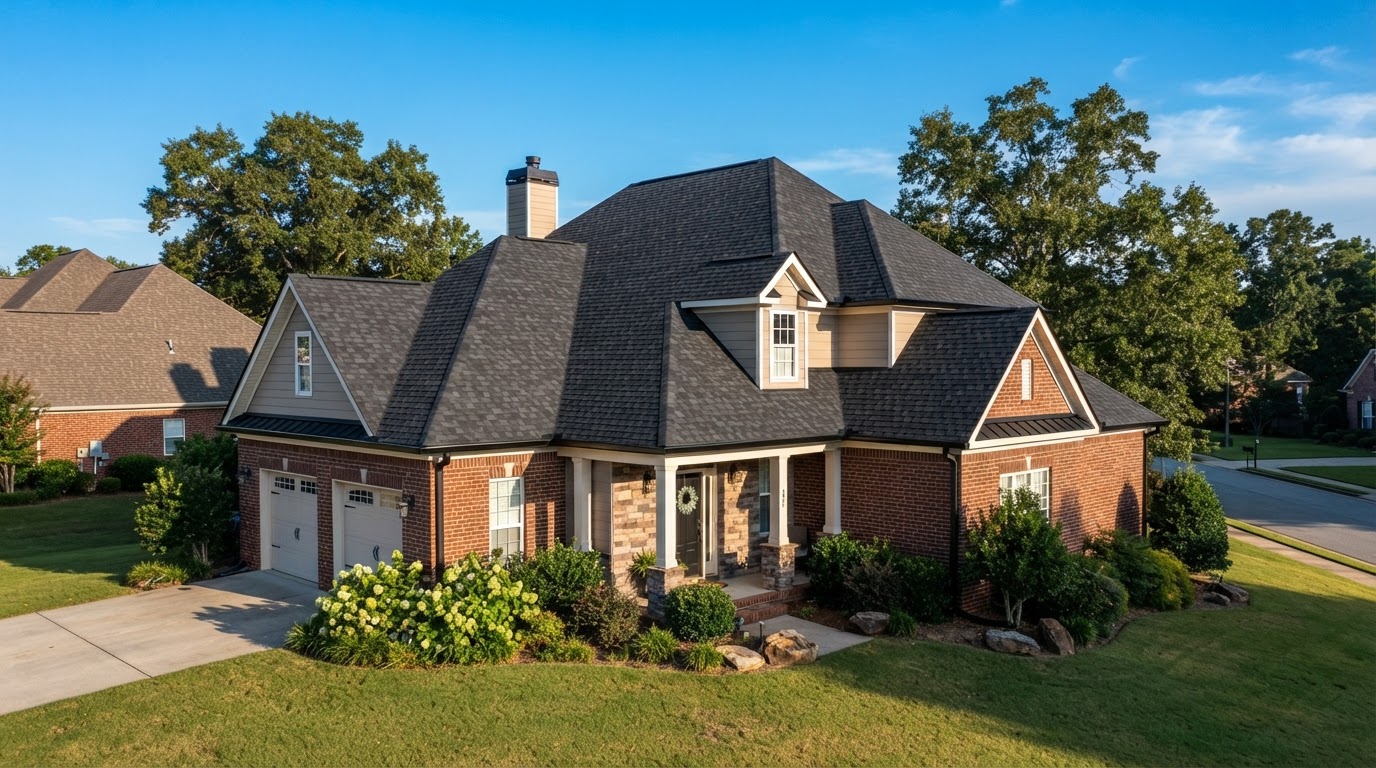
How Long Roof Replacement Takes in Montgomery
Some straightforward roofs go up quickly; larger or complex projects can take substantially longer.
Some straightforward residential roof replacements may be installed within a short working period — a manageable, accessible roof with predictable tear-off, suitable weather, and limited unexpected decking work can be completed faster than a large, complex, or commercial project. But there is no fixed number of days that applies to every roof.
It helps to separate two timelines. Preparation time covers the initial inquiry and assessment, scope development, material selection, permit and approval verification, scheduling, and delivery. On-site construction time covers tear-off, decking and underlying repairs, installation, flashing, cleanup, and any required inspections. A roof that installs in a single day still has planning, ordering, and approval steps that happen before the crew arrives — and those are part of the overall project duration.
No fixed number of days for every project
What Determines Installation Duration
Roof geometry, material, existing layers, decking, flashing, weather, and crew all factor in.
Roof size
A larger roof area means more material, more fastening, and more time per stage.
Slope and accessibility
Steeper slopes and harder access slow installation and add safety planning.
Number of roof planes
More valleys, hips, and transitions mean more detailing at each intersection.
Material type
Asphalt shingles, standing seam, exposed-fastener metal, and commercial membranes install differently.
Existing roof layers
Multiple existing layers lengthen tear-off and increase disposal.
Tear-off requirements
What has to be removed, and how it comes off, affects the on-site schedule.
Decking condition
Hidden decking damage found during tear-off adds repair scope and time.
Flashing complexity
Chimneys, skylights, valleys, and penetrations add detailing at each intersection.
Rooftop equipment
HVAC curbs, vents, and other equipment require coordinated flashing work.
Weather conditions
Rain, high winds, or unsafe conditions can delay safe installation.
Crew and material availability
Scheduling depends on labor and product lead times for the selected material.
Permitting or inspections
Required permits and inspections can add steps to the overall project.
We avoid fabricated production rates or company scheduling guarantees. The duration is defined for a specific roof and scope, not as a square-foot-per-day figure that applies to every project.
Shingle, Metal, and Commercial Systems Install Differently
Material choice changes the process — the schedules are not interchangeable.
Asphalt shingles
Courses are laid, staggered, and sealed; ridge and hip details finish the roof. Familiar but still scope-dependent.
Standing seam metal
Panels are measured, cut, formed, and seamed or clipped; the seaming process is distinct from shingle fastening.
Exposed-fastener metal
Panels are fastened through the face with specified spacing and washers; fastener placement and panel movement matter.
Commercial TPO
Membrane sheets are rolled, heat-welded at laps, and flashed at curbs and drains — a different process from steep-slope work.
Other low-slope materials
EPDM, modified bitumen, coatings, and spray foam each have their own installation sequences and curing or cure-time considerations.
We do not imply that these systems have comparable schedules. Each material has its own installation sequence, and the timeline is evaluated for the specific roof and system rather than treated as interchangeable.
A Typical Roof Replacement Timeline
From the first inquiry through closeout — not every step is a confirmed company practice.
- 1
Initial inquiry and assessment
Understanding the roof, the scope, and the conditions before any plan is made.
- 2
Scope development
Defining what the replacement includes and what it does not.
- 3
Material selection
Choosing the roof system, color, and applicable accessories.
- 4
Permit and approval verification
Confirming what the jurisdiction requires for the scope.
- 5
Scheduling and delivery
Aligning crew availability with material lead time and weather.
- 6
Existing roof removal
Tearing off the old covering where required and disposing of it.
- 7
Decking and underlying repairs
Addressing what tear-off reveals before the new system goes on.
- 8
Installation
Installing the specified roof-system components and flashing.
- 9
Cleanup and project closeout
Clearing debris, checking details, and wrapping up the project.
Not every step is universally included or performed by any particular company without confirmation. The sequence describes a typical project; the actual steps and their order are defined for the specific roof and the agreed scope.
What Commonly Causes Delays
Quality and safety take priority over an arbitrary completion promise.
Quality and safety first. Rushing a roof to meet an arbitrary date can create installation problems that cost more later than the delay itself. Where a condition makes safe or correct installation impossible on a given day, the project waits for the right conditions rather than forcing the schedule.
How Homeowners Can Prepare
Reasonable interior and access preparation — not roof-surface work.
We do not suggest homeowners inspect or prepare dangerous roof surfaces themselves. Preparation is about the interior and the access around the home — the roof itself is handled by qualified personnel with the appropriate safety setup.
Frequently Asked Questions About Roof Replacement Timelines
Clear answers about one-day work, materials, tear-off, weather, and preparation.
01.Can a roof be replaced in one day?
Some straightforward residential roof replacements on a manageable, accessible roof may be installed within a single working day, but feasibility depends on roof size and geometry, access, tear-off conditions, weather, materials, and whether unexpected decking repairs appear. Not every roof qualifies for a one-day installation, and a one-day installation window is separate from the overall project timeline — planning, ordering, permitting, and inspections still take their own time. The dedicated one-day replacement page addresses that specific question in more detail.
02.Does metal roofing take longer than shingles?
The installation processes differ. Standing-seam and exposed-fastener metal systems involve panel measurement, cutting, seaming or fastening, and flashing detailing that do not map directly onto shingle installation, and the schedules are not always comparable. The actual duration depends on the roof, the system, the flashing complexity, and the crew — we do not imply that shingles and metal always take the same time or that one is universally faster.
03.How long does tear-off usually take?
Tear-off duration depends on roof size, the number of existing layers, slope, access, and what the removal reveals. A small, straightforward roof may strip quickly; a larger or steeper roof, or one with multiple existing layers, takes longer. We do not publish fabricated production rates — tear-off time is part of the overall schedule and is defined for a specific project, not as a universal rate.
04.What happens if rotten decking is found?
When tear-off reveals deteriorated, water-damaged, or unsound decking, the damaged sections generally have to be repaired or replaced before the new roof system is installed — that work is additional scope that extends the on-site timeline. The extent of the repair depends on what the exposed deck actually shows, which is why decking condition is one of the variables that can lengthen a project beyond its initial estimate.
05.Does rain delay roofing work?
Rain and unsafe weather can delay roof replacement, because installing a roof system on a wet deck or in high winds is neither safe nor reliable. Quality and safety take priority over an arbitrary completion date, and weather delays are one of the most common reasons a project moves from its original schedule. The impact depends on the season, the forecast, and how much of the roof is exposed at the time.
06.Does scheduling time count toward project duration?
Yes. The overall project timeline includes preparation as well as on-site construction — initial inquiry and assessment, scope development, material selection, permit and approval verification, scheduling and delivery, and any required inspections. A short on-site installation window does not mean the entire project is short; the planning, ordering, and approval steps happen before the crew arrives.
07.Can I stay home during roof replacement?
Often, yes, with reasonable preparation — clearing access areas, planning for noise, keeping children and pets away from active work zones, and coordinating parking and deliveries. Some projects, particularly larger or more complex ones, may be easier to schedule around occupancy. We do not suggest homeowners inspect or prepare dangerous roof surfaces themselves; the interior preparation is what an owner can reasonably handle.
08.How long do commercial roofing projects take?
Commercial roof replacement timelines depend on the building size, the roof system (TPO, EPDM, modified bitumen, metal, and others), rooftop equipment, the number of penetrations and curbs, occupancy and access constraints, and permitting and inspection requirements. Commercial projects can run substantially longer than a straightforward residential replacement, and the timeline is defined for the specific building rather than as a universal figure.
Related Roofing Resources
Continue exploring roof replacement and project-planning topics:
Request a Roof Replacement Quote
If you are planning a roof replacement in Montgomery and want a realistic understanding of the timeline — preparation, on-site construction, material lead time, and the conditions that can extend a project — an assessment can define the scope and the schedule for your specific roof without promising a fixed number of days or a guaranteed completion date.