
Partial Roof Replacement in Montgomery
Replacing one roof section while keeping the rest is sometimes the right call — and sometimes a costly mistake. This guide explains when partial replacement fits, how it differs from a repair or a full replacement, and why the transition between new and old is the detail that makes or breaks it.
What Partial Roof Replacement Means
Removing and rebuilding a defined section while retaining the rest.
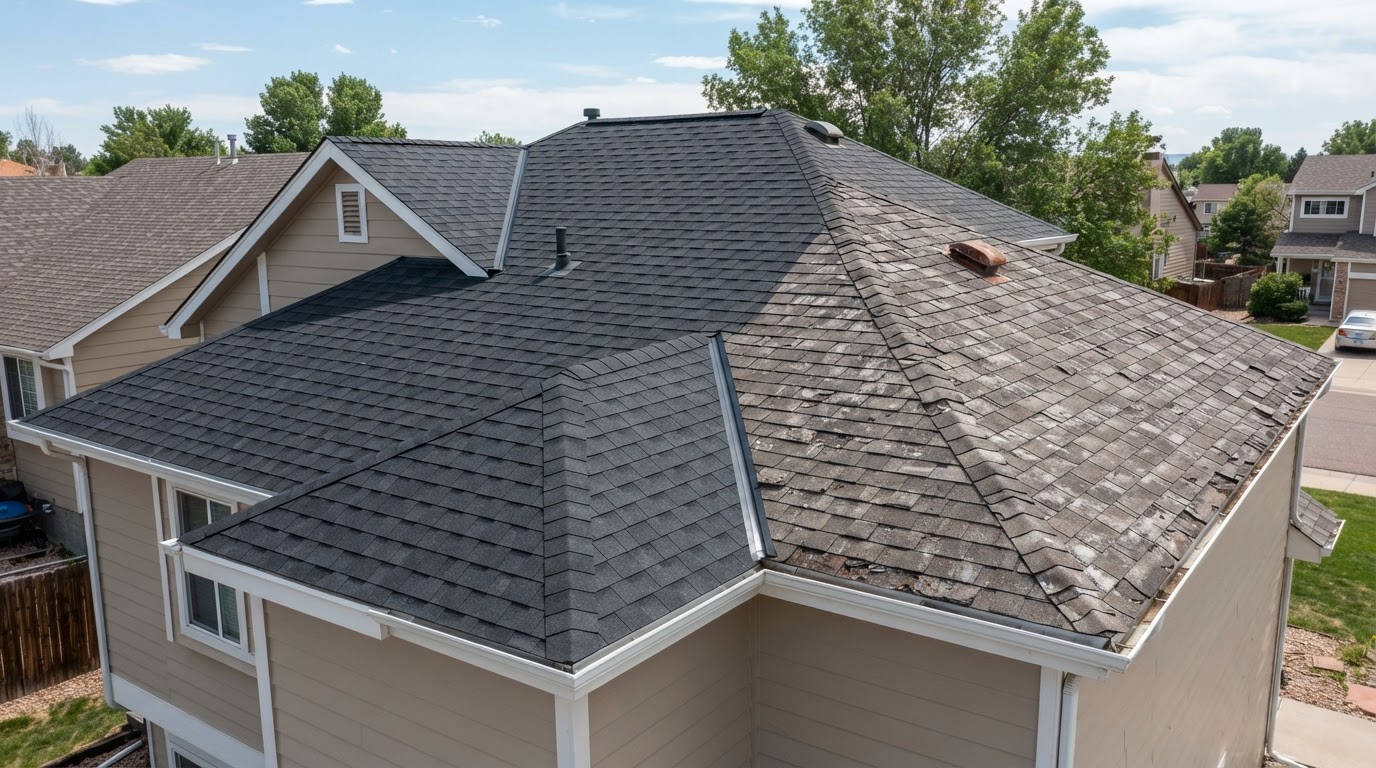
A partial roof replacement involves removing the roofing from a defined section — a single slope, a valley area, or one portion of the roof — and rebuilding it, while leaving the other portions of the existing roof in place. It sits between an isolated repair (which addresses specific shingles, flashing, or a penetration) and a full replacement (which replaces the entire roof covering or assembly within the agreed scope).
Whether it is appropriate depends on the roof's actual condition, the system design, material and system compatibility, and the quality of the transition to the retained sections. A partial replacement is not always cheaper, not always permitted, and not always the right scope — it is a choice that has to be justified by what an assessment actually finds.
Not a default money-saver
When Homeowners Consider Partial Replacement
Situations that can make a section-level replacement worth evaluating.
Damage limited to one slope
A storm or defect confined to a single roof slope may justify replacing just that area.
Localized deterioration
Deterioration beyond a spot repair but not affecting the whole roof.
A section with different aging
An addition or prior repair that ages differently from the rest of the roof.
A defined storm-damaged area
Documented storm impact concentrated in one portion of the roof.
Repeated leakage in one portion
Leaks that keep returning to the same section despite repairs.
Concentrated material or installation problems
A defect tied to one section's materials or original installation.
Visible damage does not always identify the full extent of hidden deterioration. A section that looks like the only problem can share concealed conditions with adjacent areas — which is why an assessment, not the visible damage alone, should drive the scope decision.
Partial Replacement, Isolated Repair, or Full Replacement
Three different scopes — the right one depends on how widespread the condition is.
| Scope | What It Addresses | When It May Fit |
|---|---|---|
| Localized repair | Particular shingles, flashing, fasteners, a penetration, or a detail | An isolated, repairable defect in an otherwise sound roof |
| Partial replacement | A larger, distinct roof section — a slope, valley, or area | Damage or deterioration confined to one section; rest of roof is sound |
| Full replacement | The entire roof covering or assembly within the agreed scope | Widespread deterioration, system incompatibility, or end-of-service-life conditions |
Widespread deterioration, incompatible roofing, moisture damage across areas, structural concerns, or integration difficulties can all favor a broader solution. The scope should follow the findings — not the other way around.
Technical Planning and Limitations
A partial replacement is a transition project — the detail at the seam is everything.
Shingle matching is rarely exact. Even when a currently available product carries the same stated color, batch differences and the weathering of the existing roof usually mean a close — not identical — match. We do not promise a perfect match, and a visible difference at the transition is common.
We do not describe asphalt-shingle methods as universally suitable for standing-seam, exposed-fastener metal, TPO, or other systems. For commercial membrane roofs, visitors should be directed to the appropriate commercial repair and recover resources — residential partial-replacement methods are not a universal approach.
Decision-Making and Cost Considerations
Price depends on the actual scope — not on a fixed price list.
The cost of a partial replacement depends on the area and geometry, the material type, the tear-off and disposal involved, the complexity of the transition, the decking condition revealed, access and safety requirements, the existing roof's compatibility, and what an inspection finds. Each of those varies by roof, so there is no fixed price — and no company price list to publish.
Not always cheaper over time. A partial replacement can cost less upfront, but if the remaining roof is near the end of its useful life, paying for a partial now and a full replacement soon can cost more over the roof's remaining life than a single full replacement. The right financial decision depends on the condition of the whole roof, not on the area alone.
The honest way to decide is to assess the entire roof — the section in question and the sections that would remain — and weigh the scope, the transition, the remaining life of the retained roofing, and the total cost over time. That is the basis for a sound decision, not a default assumption that partial is always the economical choice.
Frequently Asked Questions About Partial Roof Replacement
Clear answers about scope, matching, and the repair-versus-replace decision.
01.Can I replace only one side of my roof?
Sometimes. When deterioration or damage is genuinely confined to one slope or section, partial replacement may be appropriate. The decision depends on the condition of the rest of the roof, material and system compatibility, how well a new section can transition into the existing roof, and applicable code and manufacturer requirements. It is not a universal option — an assessment determines whether it fits a specific roof.
02.Is partial replacement cheaper than replacing everything?
It can be, because it involves less area, material, and labor — but not always. A partial replacement also adds a transition detail, and if the remaining roof is near the end of its life, paying for a partial now and a full replacement soon can cost more over time than addressing the whole roof once. We do not promise partial replacement is always the lower-cost choice over the roof's remaining life.
03.Will new shingles match the existing roof?
Not exactly, in most cases. Even when a currently available product has the same stated color as the existing shingles, manufacturing batches, weathering of the older roof, and product changes over time mean a close match is typical rather than an exact one. We do not promise a perfect color match, and a visible difference at the transition is common.
04.Can partial replacement create leaks at the transition?
It can, if the transition is not detailed correctly. The joint between the new section and the retained roof is the most critical detail in a partial replacement — underlayment continuity, flashing, valley integration, and edge conditions all have to be handled properly. A well-planned transition is durable; a poorly detailed one is a common source of future leaks. That transition is exactly why a partial replacement is not the same as a simple repair.
05.What if the existing roof is near the end of its useful life?
If the remaining roof is broadly aged or deteriorating, a partial replacement can be a poor investment — you would be tying a new section into a roof that is itself nearing replacement. In that situation, a full replacement often makes more sense, because it addresses the whole assembly at once and avoids a transition into failing material. The right call depends on the actual condition of the rest of the roof, assessed on site.
06.Can only one damaged section of a metal roof be replaced?
Sometimes, depending on the panel profile, fastening system, and how the damaged section connects to adjacent panels. Standing-seam, exposed-fastener, and stone-coated systems behave differently, and a partial metal replacement has to respect the product's attachment and weatherlap details. We do not describe asphalt-shingle methods as suitable for metal, TPO, or other systems — the method has to match the material.
07.Does a partial replacement affect a warranty?
It can. Manufacturer warranty terms vary by product, and some warranties depend on a complete installation or have conditions that a partial replacement may affect. Any warranty that applies is the one actually provided with the project — we do not invent warranty terms. Review the specific product's warranty language before deciding on a partial scope.
08.How is partial replacement different from roof repair?
A localized repair addresses particular shingles, flashing, fasteners, or a penetration. A partial replacement removes and rebuilds a larger, distinct roof section — a whole slope, valley, or area — while retaining other portions. A full replacement replaces the relevant entire roof covering or assembly within the agreed scope. The three are not interchangeable; the right one depends on how widespread the condition is.
Related Roofing Resources
Continue exploring replacement, repair, and material-specific topics:
Request a Partial Roof Replacement Assessment
If one section of your roof is failing but the rest seems sound, an on-site assessment can determine whether a partial replacement is the right scope — or whether the condition of the remaining roof makes a full replacement the better long-term decision. We will not assume partial is always cheaper; we will base the recommendation on what the roof actually shows.