
Roof Leaking Around the Chimney Montgomery
A leak near the chimney usually points to the roof-to-chimney intersection — but the visible stain rarely reveals the exact entry point. This guide explains the components involved, why water travels, and which repairs actually hold up.
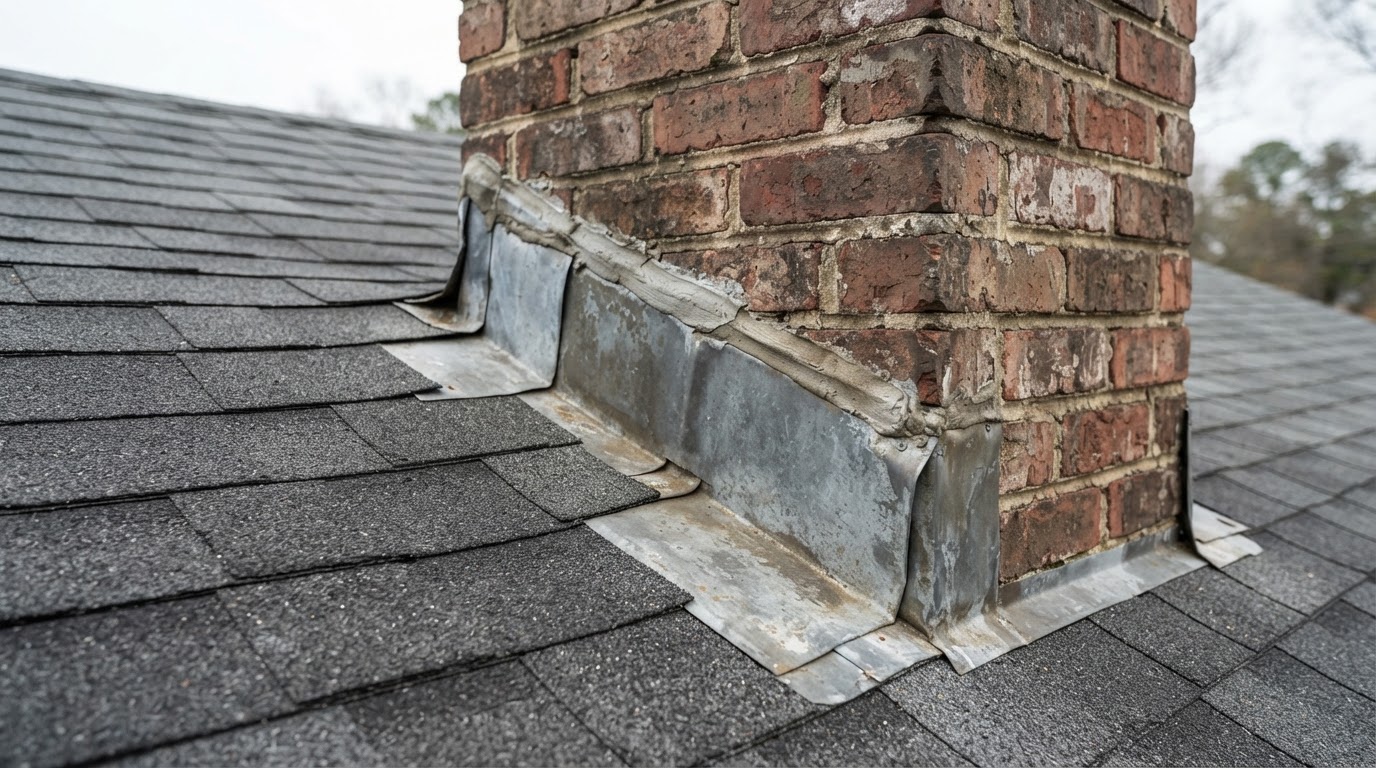
Why Roofs Leak Around Chimneys
The roof-to-chimney intersection is one of the most complex transitions on a roof.
A chimney punches a large opening through the roof, and every component at that intersection has to work together to keep water out. When any one of them fails, water can find its way in — and because water often travels along framing or decking before appearing indoors, the stain you see is not always directly below the entry point.
The components that matter at a chimney include step flashing, counterflashing, back flashing, a chimney saddle or cricket on larger chimneys, the chimney cap and crown, and the masonry joints themselves. A leak is not automatically a flashing defect — it can come from masonry, a cracked crown, or a failed cap just as easily.
Step flashing
L-shaped pieces woven into each shingle course where the roof meets the chimney side
Counterflashing
Metal flashing set into the masonry and folded down over the step flashing to shed water
Back flashing / apron
Flashing at the uphill side and base of the chimney where water concentrates
Chimney saddle or cricket
A small peaked structure behind a larger chimney to divert water around it, when applicable
Chimney cap and crown
The covering and sloped top that shed water away from the flue and masonry
Masonry joints
Mortar joints that can deteriorate and allow water into the chimney structure
Common Symptoms of a Chimney-Area Leak
What homeowners typically notice — and why the visible mark can mislead.
- Ceiling staining or discoloration near the fireplace
- Damp or musty interior surfaces around the chimney
- Watermarks or moisture in an accessible attic near the chimney
- Leaks that recur during rainfall, especially wind-driven rain
- Damaged, loose, or visibly deteriorated flashing
- Spalling brick or deteriorated mortar around the chimney
Water travels before it shows
Chimney Flashing Inspection and Assessment
A qualified professional evaluates the whole intersection, not just the obvious spot.
A proper assessment looks at the continuity of the flashing, the condition of the roof material around the chimney, the chimney-to-roof intersection on all sides, adjacent penetrations, the state of any sealant, and the masonry and cap. The goal is to identify where water is actually entering rather than assuming the cause from the interior stain.
A visual inspection is a strong starting point, but it does not always pinpoint the exact entry location — especially with intermittent leaks that appear only in certain wind or rain conditions. In those cases, correlating the leak with weather patterns and reviewing the most likely paths water could take is part of a thorough investigation.
Repair Options for a Chimney-Area Leak
The right fix depends on which component is actually failing.
Possible repair paths include localized flashing repairs when a single section has failed, replacement of incompatible or deteriorated flashing components, coordinated roofing work to restore the shingle integration around the chimney, and evaluation of adjacent shingles that may have been compromised by the leak.
It is important to distinguish a temporary sealant patch from a durable, properly integrated flashing solution. Sealant can buy time, but a lasting repair usually means reinstalling flashing so the assembly sheds water by design. When masonry or cap issues are involved, additional chimney or masonry services may be necessary.
Don't climb onto a wet roof. Chimney leaks are frustrating, but a fall from a roof is far more serious. Document what you can see safely from the ground or inside, and leave the on-roof investigation to a qualified professional.
Roofing Versus Chimney and Masonry Work
Some causes fall within roofing scope; others require a chimney or masonry specialist.
Roofing work covers the roof-side of the chimney intersection: step flashing, counterflashing, back flashing, shingle integration, and the surrounding roof assembly. When the leak originates in the flashing or the roof material, a roofing contractor is the right professional for the repair.
Masonry and chimney work — rebuilding a chimney, repointing mortar joints, restoring a cracked crown, fabricating or replacing a chimney cap, or servicing a flue — typically requires a qualified chimney or masonry specialist. We do not claim to perform chimney rebuilding, structural masonry, or cap fabrication unless that capability is confirmed. An assessment can help determine which scope applies to your situation and whether a referral to a chimney specialist is appropriate.
Frequently Asked Questions About Chimney Roof Leaks
Clear answers about water entry, flashing, and repair scope.
01.Why does my roof leak around the chimney?
Water enters near a chimney when the roof-to-chimney intersection fails to shed water reliably. That intersection relies on several components — step flashing, counterflashing, back flashing, and sometimes a chimney saddle — working together with the surrounding shingles and the masonry itself. A leak can come from a gap in any of these, from deteriorated mortar, from a cracked cap or crown, or from water traveling in from a different point than where the stain appears. That is why a chimney-area leak is not always a flashing problem.
02.Is chimney flashing a common source of leaks?
Yes, flashing is one of the more common sources, because the roof-to-chimney joint is a complex transition that handles a lot of water. But 'common' is not the same as 'always.' A leak can also originate from masonry deterioration, a failed cap or crown, ice dams, or a defect in the shingles or underlayment nearby. Assuming the flashing is the cause without an on-site evaluation can lead to repairs that do not solve the actual problem.
03.Can chimney leaks occur even when shingles look intact?
Absolutely. The shingles around a chimney can look perfectly fine while water enters through a gap in the counterflashing, a cracked mortar joint, or a failed cap. Water is skilled at finding small openings at transitions, and the visible shingle surface is only one part of the assembly. An interior stain near the fireplace is a reason to investigate the whole intersection, not just the shingles.
04.Will caulk permanently repair a leaking chimney?
Usually not. Caulk or sealant can temporarily slow a leak at an obvious gap, but it is not a durable substitute for properly integrated, mechanically fastened flashing. Sealants age, shrink, and eventually fail — especially on a hot roof surface exposed to Alabama weather. A lasting repair typically involves reinstalling or replacing flashing components so the assembly sheds water by design rather than relying on a bead of sealant.
05.When does chimney flashing need replacement?
Flashing may need replacement when it is corroded, loose, improperly installed, incompatible with the roof material, or damaged beyond a localized repair. If the flashing was never installed correctly — for example, counterflashing simply surface-mounted rather than set into the masonry — replacement is often the right answer. A qualified assessment can determine whether a localized repair will hold or whether the flashing system should be rebuilt.
06.Can damaged chimney masonry cause water intrusion?
Yes. Deteriorated mortar joints, spalling brick, a cracked crown, or a failed cap can all allow water into the chimney structure, and that water can appear as an interior leak even when the roof flashing is sound. Masonry-related water entry is a real possibility, which is why some chimney leaks require masonry or chimney-specialist work rather than roofing work alone.
07.Do I need a roofing contractor or chimney specialist?
It depends on where the water is entering. Roofing work — step flashing, counterflashing, shingle integration, and the roof-side of the transition — falls within a roofing contractor's scope. Masonry repair, chimney rebuilding, crown restoration, flue work, and cap fabrication typically require a qualified chimney or masonry specialist. We do not claim to perform chimney rebuilding, structural masonry, or cap fabrication unless that capability is confirmed. An assessment can help clarify which scope applies to your situation.
Related Roofing Resources
Continue exploring roof leaks, flashing, and repair options:
Request a Roof Assessment
If water is appearing near your chimney, an on-site assessment can investigate the whole roof-to-chimney intersection — flashing, shingles, and the surrounding assembly — to identify where water is actually entering and what repair scope makes sense.