
Roof Leaking Only in Heavy Rain? Causes and Repair Near Montgomery
A roof that stays dry in light rain but leaks during a downpour usually has a vulnerability that only volume or wind can expose. This guide explains why heavy-rain leaks behave differently, where to look, and why the visible stain is rarely the actual entry point.
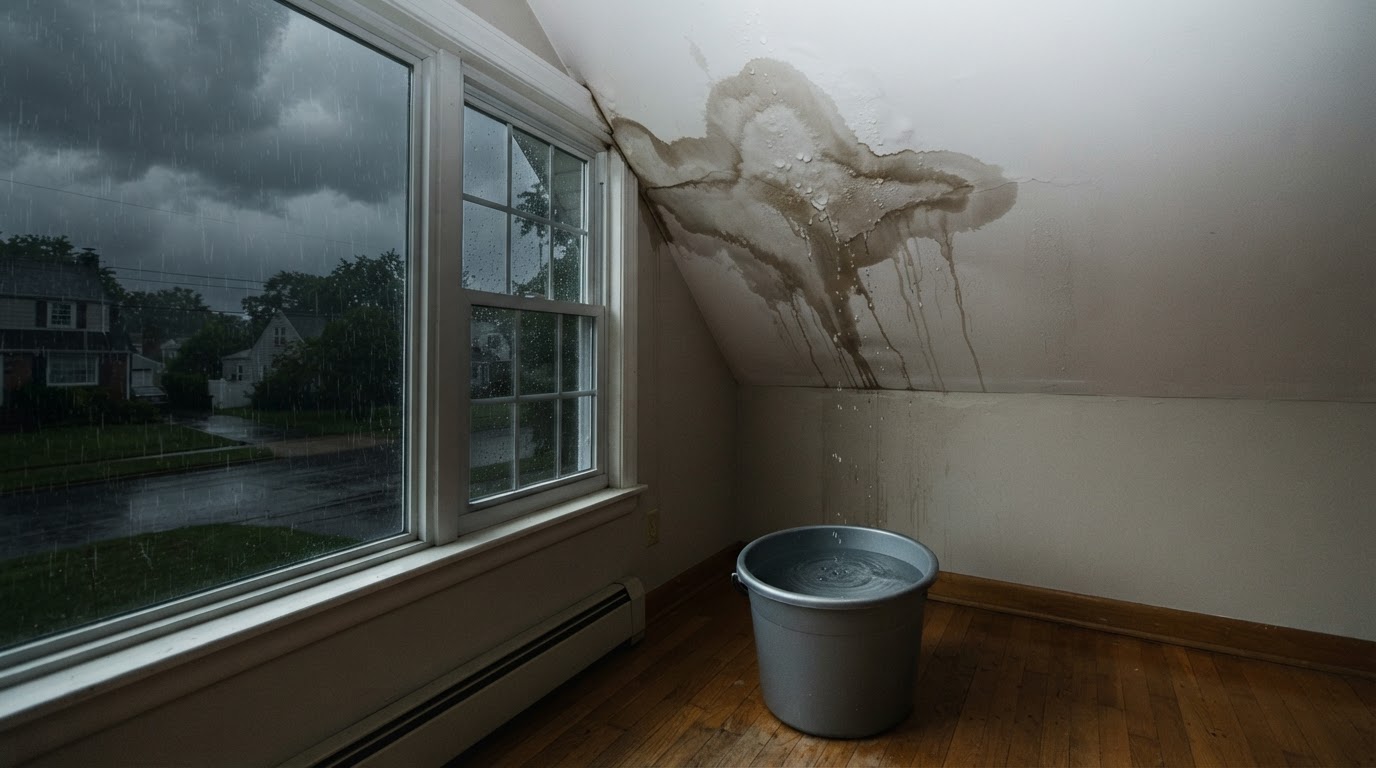
Why a Roof Might Leak Only During Heavy Rain
Volume and wind expose vulnerabilities that ordinary rainfall never reaches.
There is a meaningful difference between ordinary rainfall, prolonged rainfall, and wind-driven rain. Light rain produces a modest volume of water moving downhill, which a sound roof sheds easily. Heavy rain delivers far more water, and if a transition point — a valley, a flashing intersection, an edge detail — is only marginally sound, that volume can overwhelm it. Wind-driven rain adds another force entirely: it pushes water uphill, sideways, and behind components that gravity alone would protect.
This is why a roof can be dry for months and then leak during one specific storm. The leak is not necessarily new; the conditions that expose it are. It would be a mistake to assume every heavy-rain leak points to a shingle defect — the cause is very often at a transition or penetration where water is funneled or forced.
Volume and direction matter
Common Areas Worth Evaluating
Transitions and penetrations — where water concentrates — are the usual suspects.
Roof valleys
Concentrate large volumes of water where two slopes meet
Flashing intersections
Transitions at walls, chimneys, and skylights rely on seals
Chimneys
Complex flashing and masonry that can fail under wind-driven rain
Skylights
Curbs, gaskets, and flashing that age and admit water
Vent pipes
Pipe boots and flashing that crack or deteriorate over time
Roof edges
Drip edge and fascia details that can allow wind-driven water behind
Low-slope transitions
Slow runoff on shallow slopes gives water more time to find gaps
Drainage restrictions
Clogged gutters or scuppers back water up under edges
Damaged materials
Lifted, cracked, or displaced coverings open paths for water
These are common areas to evaluate, not a universal checklist. The right places to look depend on the roof's configuration, the leak's behavior, and the weather conditions that trigger it.
Why Leak Location Can Be Misleading
Water rarely falls straight down from where it enters.
One of the trickiest things about a roof leak is that the visible interior damage is often far from the actual entry point. Once water gets past the roof covering, it can travel along the underside of the decking, run down a rafter, follow a framing member, or pool at the lowest point in the ceiling assembly. A stain in the middle of a room can originate at a valley, a chimney, or a vent pipe many feet away.
This is why treating the stain as the source usually leads to repairs that do not hold. The stain tells you water arrived there; it does not tell you where it came in. A proper investigation works backward from the interior evidence to the most likely exterior entry paths.
Rain-Pattern Documentation
Safe, simple records help an assessor pinpoint the source.
Before an assessment, it helps to gather a few safe observations. These details make it much easier to correlate the leak with specific conditions:
- Whether wind accompanied the rainfall, and from which direction
- Approximate duration and intensity of the precipitation
- Where the interior stain appeared and how quickly
- Whether the condition has repeated after previous storms or repairs
- Any changes you noticed after past repair attempts
Stay safe while documenting
How Roofing Professionals Investigate Intermittent Leaks
A systematic review — because one look during dry weather is rarely enough.
Investigating an intermittent leak means reviewing the roof coverings, the flashing at transitions and penetrations, the drainage paths, and any accessible interior evidence. Because the leak appears only under certain conditions, the investigation often has to consider several potential sources rather than confirming one on sight.
It is honest to acknowledge that a single visual inspection during dry weather does not always resolve an intermittent leak. Correlating the leak with weather patterns, reviewing the most likely water paths, and sometimes waiting for the next event to confirm a hypothesis are all part of a thorough process. No responsible assessment guarantees an instant answer for every intermittent leak.
Repair Versus Replacement Considerations
The right scope depends on whether the leak is isolated or systemic.
If the leak traces to a localized defect — a single flashing intersection, a failed pipe boot, a damaged valley — a targeted repair is often the appropriate response. The rest of the roof may be sound, and replacing it would be unnecessary.
Replacement becomes appropriate when the leak reflects broader roofing-system deterioration: widespread flashing failure, an aging covering, multiple recurring leaks in different areas, or storm damage that compromises the whole assembly. The proper scope depends on the actual findings, not on the fact that the leak is intermittent or appears only in heavy rain.
Frequently Asked Questions About Heavy-Rain Roof Leaks
Clear answers about weather-dependent leaks and how they are investigated.
01.Why does my roof leak only during heavy rain?
A roof that holds up in light rain but leaks in heavy rain usually has a vulnerability that only becomes apparent under volume or wind. Heavy rain produces more water than a marginal seal can handle, and wind-driven rain pushes water uphill and sideways into transitions that ordinary rainfall never reaches. The leak may also be intermittent because it depends on wind direction hitting a specific slope. The cause is often a transition point — a valley, flashing intersection, penetration, or edge detail — rather than a hole in the middle of a shingle.
02.Can wind-driven rain cause leaks without missing shingles?
Yes. Wind-driven rain can force water up under shingle tabs, behind flashing, and into gaps that look perfectly intact from the ground. Shingles shed water by overlapping and gravity; when wind overcomes that overlap, water can travel backward along the roof surface. This is why a roof can have no visible missing shingles and still leak in a storm with strong wind and heavy rain.
03.Can clogged gutters contribute to water entry?
They can. When gutters or downspouts are blocked, water backs up along the roof edge and can find its way behind the fascia or under the edge of the roof covering. This tends to show up as a leak near the eaves during or after heavy rain. Cleaning and restoring drainage is often part of resolving an edge-related leak, though it is not the cause of every heavy-rain leak.
04.Why is the ceiling stain far from the roof problem?
Water does not fall straight down from where it enters. It can travel along the underside of the roof deck, run down a rafter, follow a framing member, or pool at a low point in the ceiling far from the entry point. A stain near a light fixture or in the middle of a room can originate at a valley, a chimney, or a vent penetration many feet away. The visible mark is a clue, not a map.
05.Can flashing fail only during certain weather conditions?
Yes. Flashing that is marginal — slightly lifted, aged, or missing a seal — may hold up in calm rain but fail when wind drives water against it at the right angle. The same flashing can be dry in one storm and leak in another depending on wind direction and intensity. This intermittent behavior is exactly why a single visual check during dry weather may not reveal the problem.
06.Does an intermittent leak require roof replacement?
Not necessarily. If the leak traces to a localized defect — a single flashing intersection, a failed pipe boot, or a damaged valley — a targeted repair may resolve it. Replacement becomes appropriate when the leak reflects broad deterioration, when the roof is near the end of its service life, or when multiple areas are failing. The right scope depends on the actual findings, not on the fact that a leak is intermittent.
07.How can I document the problem before an assessment?
Safely record whether wind accompanied the rainfall, roughly how long and how hard it rained, where the interior stain appeared, and whether the condition has repeated after previous storms. Note any changes after past repairs. Photograph the interior damage from a safe location. Do not climb into a wet attic or onto a wet roof to investigate — the documentation that matters can be gathered safely from inside and from the ground.
Related Roofing Resources
Continue exploring roof leaks, flashing, and storm-related water entry:
Request a Roof Assessment
If your roof leaks only during heavy rain, an on-site assessment can investigate the transitions, penetrations, and drainage paths that volume and wind expose — and help determine whether a targeted repair or broader work is the right response.