
Gutter Installation Montgomery
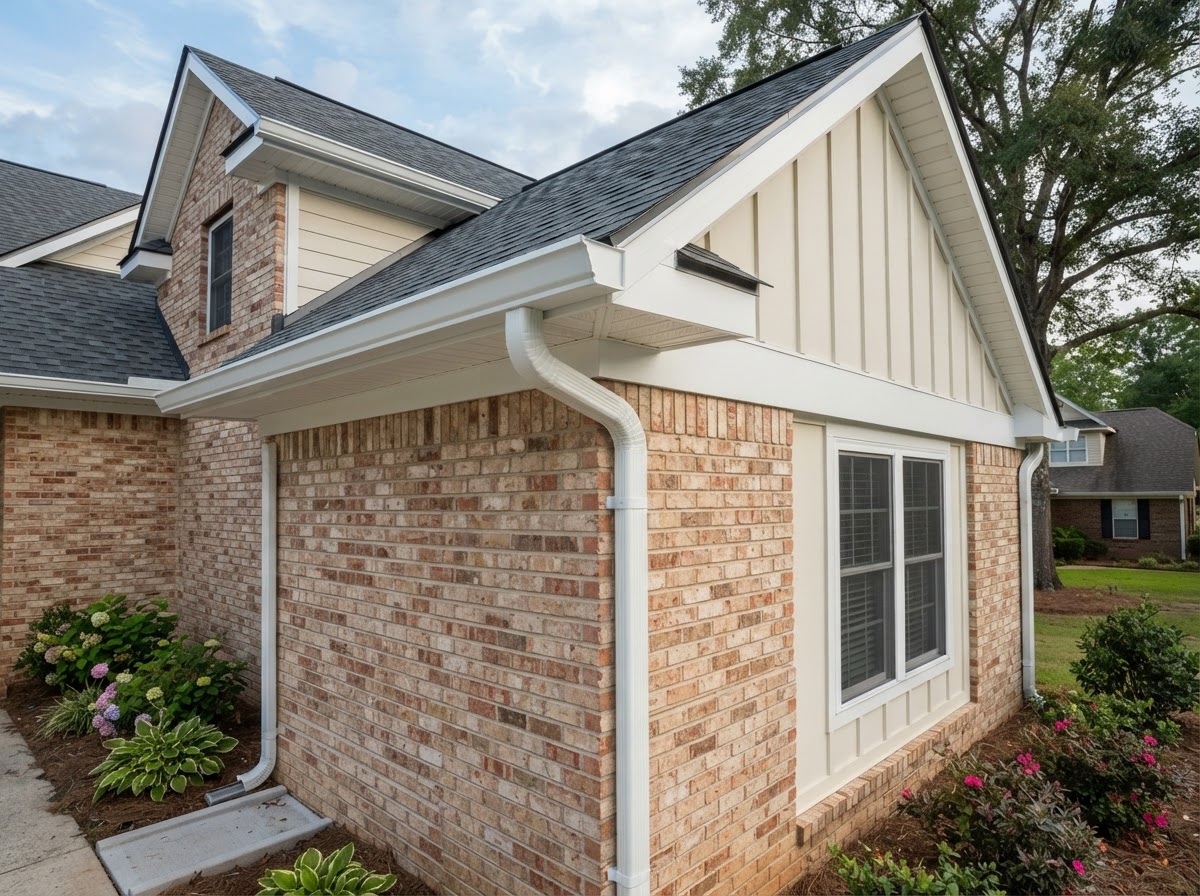
Gutters work with your roof to guide rainfall away from vulnerable building areas. A properly planned system considers the roofline, downspouts, discharge locations, and the condition of the supporting fascia. This page covers the full gutter system — gutters, downspouts, outlets, hangers, and roof-edge coordination — without duplicating the seamless fabrication or guard selection pages.
When to Consider New Gutters in Montgomery
Missing Gutters on Vulnerable Roof Edges
Roof sections without gutters shed water directly onto siding, entries, or grade next to the foundation. Not every roof edge requires a gutter, but vulnerable edges usually do.
Sagging or Separated Gutters
Gutters that pull away from the fascia or sag between hangers no longer carry water efficiently. Sagging often indicates failed fasteners, deteriorated fascia, or undersized supports.
Leaking Connections
Drips at seams, corners, or end caps show the joints are no longer sealed. Sectional gutters leak at connections; even seamless runs leak at corners and outlets.
Overflow During Rainfall
Water pouring over the gutter edge can mean clogs, undersized gutters, or a slope problem. Overflow that recurs after cleaning usually points to a sizing or layout issue.
Recurring Blockages
Frequent clogs at the same section may mean the gutter is too low, too flat, or located under a debris source like a tree or valley.
Downspout Problems
Downspouts that disconnect, crush, or discharge too close to the foundation cannot move water far enough from the building. Extensions and proper discharge planning are part of the system.
Corrosion or Physical Damage
Rust, dents, holes, or bent profiles reduce the gutter's capacity and shorten its service life. Aluminum resists rust but can dent; steel can corrode if the coating fails.
Fascia Deterioration
Rotting or soft fascia cannot hold gutter fasteners securely. If the fascia is compromised, gutter replacement alone may not solve the attachment problem.
A clogged gutter is different from a system that is improperly sized, poorly positioned, damaged, or missing adequate discharge capacity. Not every moisture issue at a foundation is caused by a gutter problem.
Planning Residential Gutter Installation Near Montgomery
A gutter installation is a system, not just a run of metal. The process reviews the roof edge, the runoff, the supports, and the discharge path before any material is selected.
1. Property and roof-edge evaluation
Roof planes, eave lengths, valley discharge points, and vulnerable edges that need protection.
2. Review existing runoff patterns
Where water currently goes during rain, including any problems it causes at grade, siding, or foundation.
3. Inspect accessible fascia
Whether the fascia is sound enough to hold fasteners, or whether repair or replacement is needed first.
4. Measurements and profiles
Gutter size, profile (K-style, half-round), and slope calculations based on roof area and rainfall.
5. Downspout and discharge planning
Number, location, and discharge path for each downspout, including extensions or connections.
6. Material and finish selection
Aluminum, steel, or other suitable metals, with color coordinated to the exterior.
7. Removal of old components
If existing gutters are present, removal and disposal are included in the scope.
8. Installation and water-flow checks
Secure attachment, proper slope, sealed corners, and a flow test at downspouts.
If concealed damage is discovered during removal, its treatment depends on the agreed scope and any required additional work. Not all fascia or drainage issues can be corrected through gutter replacement alone.
Choosing a Gutter System for a Montgomery Home
Gutter Materials
Aluminum is common for residential gutters because it resists rust, is lightweight, and accepts baked-enamel finishes. Steel is stronger but can corrode if the coating is damaged. Material choice affects appearance, cost, and maintenance.
Gutter Profiles
K-style gutters carry more water for a given width and have a decorative face that suits many homes. Half-round gutters have a simpler appearance and are often chosen for historic or specific architectural styles. Profile suitability depends on the property.
Sectional vs. Seamless Gutters
Sectional gutters are assembled from pre-cut lengths with joints at each connection. Seamless gutters are formed on-site in continuous runs with fewer joints along straight sections. See the seamless gutter page for fabrication details.
Downspouts and Discharge
Downspouts carry roof runoff to the ground. Discharge location, extensions, and drainage connections must move water away from the foundation. Underground drainage is a separate scope that depends on grading and site conditions.
Gutter Sizing and Roof Geometry
Roof area, roof shape, rainfall intensity, and outlet placement influence the gutter size and slope needed. Undersized gutters overflow; oversized gutters cost more and may look out of scale.
Fascia and Roof-Edge Coordination
The fascia must be sound enough to hold fasteners. Drip edge, roof-covering details, and gutter attachment interact at the roof edge. Hidden damage is not proven without inspection.
Maintenance
Clearing debris, observing overflow, checking for loose sections, and monitoring downspout discharge are ongoing tasks. Ground-level observation is safe; elevated work requires qualified help.
Gutters Do Not Solve Every Water Problem
Gutters manage roof runoff. They do not prevent all flooding, foundation movement, water intrusion through walls, or landscaping erosion. Site grading, drainage, and foundation waterproofing are separate concerns that gutter replacement alone does not address.
Gutter Installation Questions in Montgomery
How do I know whether to repair or replace my gutters?
If gutters are sagging, corroded, leaking at many joints, or pulling away from the fascia, replacement is usually more practical than repeated repairs. If the problem is isolated to one section or a single leak, a repair may be sufficient.
Are gutters necessary on every roof edge?
Not every edge needs a gutter. Vulnerable edges — those over entries, siding, or grade near the foundation — usually do. A short eave that sheds water onto open grade may not need one. The decision follows the roof and the site.
Should I replace gutters when replacing the roof?
Coordinating gutter and roof replacement is often efficient because the roof edge, drip edge, and fascia are exposed during reroofing. If the existing gutters are sound and compatible, they may be reinstalled; if not, replacement is planned with the roof.
What is included in a new gutter installation?
Gutters, downspouts, end caps, corners, hangers or brackets, and the discharge path. Removal and disposal of old gutters, if present, is part of the scope. Fascia repair and underground drainage are separate unless explicitly included.
Why do my gutters overflow even when they look clean?
Overflow with clear gutters usually means the system is undersized for the roof area, the slope is too flat, or a downspout is restricted. Cleaning solves clogs; it does not solve sizing or slope problems.
How are downspout locations determined?
Downspouts are placed based on roof area, gutter length, discharge path, and site grading. The goal is to move water away from the foundation and vulnerable areas without creating new problems at the discharge point.
What factors affect the cost of residential gutters?
Total gutter length, number of corners and downspouts, material, profile, fascia condition, access, removal of existing gutters, and whether the project is part of a larger roof replacement. Gutter configuration is property-specific.
Request a Gutter Installation Quote in Montgomery
Describe whether the inquiry is a complete replacement, missing gutters, damaged runs, downspout concerns, or drainage planning. The roofline, fascia condition, and discharge path help define the scope.