
Gutter Guards Montgomery
Gutter guards may help reduce the amount of leaves and debris entering a gutter system, but the best option depends on surrounding vegetation, the existing gutters, roof material, and maintenance expectations. This page covers guard types, compatibility, performance tradeoffs, and maintenance — without claiming any guard prevents every clog or eliminates cleaning permanently.
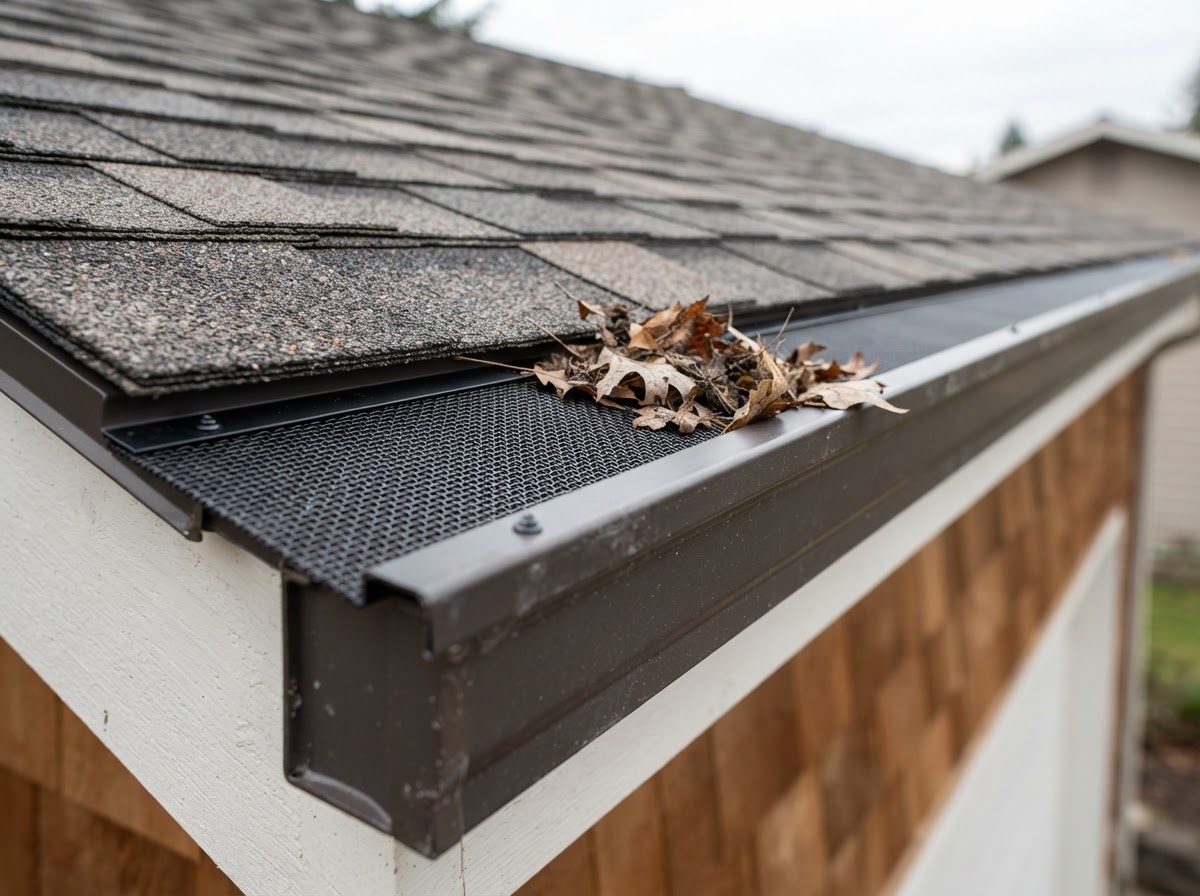
When Gutter Guards May Help Montgomery Homeowners
Leaves and Larger Debris
Open gutters collect leaves, twigs, and granules that decompose into a sludge. Guards that screen out larger debris reduce the volume of material that reaches the gutter bottom.
Recurring Cleaning Needs
If gutters need cleaning several times a year, a guard may reduce the frequency. Guards do not eliminate cleaning — they change how often it is needed.
Roof Valleys Directing Debris
Valleys concentrate water and debris into specific gutter sections. A guard at a valley run may clog faster than one on a straight eave and need more frequent attention.
Tree Cover Near Roof Edges
Properties with mature trees overhanging the roof produce more debris than exposed properties. The tree species and distance from the roof affect how much guard work is needed.
Blockages at Outlets and Downspouts
Debris often collects where the gutter narrows into the downspout. Guards help keep the outlet clear, which protects the downspout from clogging.
Rainwater Overflowing Obstructed Gutters
When gutters fill with debris, water overflows the edge instead of reaching the downspout. Guards that keep the channel open reduce overflow events.
Reducing Maintenance Frequency
The appeal of a guard is less frequent cleaning, not zero cleaning. The right product for the property can extend the interval between service visits.
A guard is not necessarily the right first step if gutters are sagging, detached, damaged, or poorly draining. Those problems must be corrected before a guard is installed, or the guard will not perform as expected.
Evaluating Gutter Guard Installation in Montgomery
A guard is only as good as its fit with the existing system. The assessment reviews the gutters, the debris problem, and the roof edge before any product is selected.
1. Review existing gutters and downspouts
Profile, dimensions, condition, and whether the gutters are sound enough to accept a guard.
2. Identify the primary debris problem
Leaves, needles, granules, or a mix — each debris type suits a different guard style.
3. Check visible condition and attachment
Sagging, separation, or damaged fasteners must be corrected before a guard is added.
4. Review roof material and edge
Some guards attach under the shingles, others to the gutter lip or fascia. The attachment method must be compatible with the roof system.
5. Compare suitable guard categories
Screen, micro-mesh, solid-cover, or perforated metal — each has different debris exclusion and maintenance profiles.
6. Review installation requirements
Attachment method, roof-edge implications, and any manufacturer instructions that govern the install.
7. Discuss maintenance and access
How the guard is cleaned, whether it can be lifted, and what happens when debris accumulates on top.
8. Install the selected system
If verified as an available service, install per the product and roof-system requirements.
Attaching a guard under shingles or altering the roof edge may affect roof-material warranties. The actual product instructions and roof-system requirements govern the installation method.
Comparing Gutter Guard Types Near Montgomery
Screen-Style Guards
Open mesh that blocks larger leaves and twigs while letting water through. Smaller debris, pollen, and granules can pass through or collect on the surface. Periodic cleaning is still required.
Micro-Mesh Guards
Finer openings exclude more small debris than standard screens. Surface accumulation can still occur, and fine material may collect on top of the mesh rather than passing through.
Solid-Cover or Surface-tension
Covers that rely on water adhering to a curved edge and flowing into the gutter while debris slides off. Performance depends on rainfall intensity, roof edge detail, and installation.
Perforated Metal Systems
Metal panels with punched holes that block larger debris. Opening size, support, and material differ by product. Durable, but still requires periodic inspection.
Compatibility with Existing Gutters
Guard dimensions, profile, and attachment must match the existing gutter. A guard designed for K-style may not fit half-round, and vice versa.
Heavy Rainfall Considerations
Performance depends on system design, flow conditions, debris accumulation, and installation. No guard handles every severe rain event without some overflow.
Ongoing Maintenance
Guarded gutters still need periodic observation and may require cleaning. Debris can accumulate on top of guards, at valleys, in outlets, or inside downspouts.
Guards vs. Complete Gutter Replacement
Repair, new gutters, drainage corrections, or guard installation may each be the right answer depending on the problem. A guard does not fix damaged gutters or poor drainage.
No Clog-Free Guarantee
This page does not advertise product warranties, clog-free guarantees, or installer-specific maintenance programs. Product registration terms, exclusions, and provider obligations vary by product and must be confirmed before any promise is made. Guards reduce maintenance — they do not eliminate it.
Gutter Guard Questions From Montgomery Homeowners
Do gutter guards eliminate gutter cleaning?
No. Guards reduce the amount and frequency of cleaning, but debris can still accumulate on top of the guard, at valleys, or inside downspouts. Most guarded systems still need periodic inspection and occasional cleaning.
Will gutter guards work with my existing gutters?
It depends on the gutter profile, dimensions, and condition. Some guards are designed for standard K-style or half-round profiles; others are product-specific. Damaged or undersized gutters may need replacement before a guard is added.
Are micro-mesh guards better than basic screens?
Micro-mesh excludes finer debris but can collect more material on the surface. Basic screens let more fine debris through but may require less surface cleaning. The right choice depends on the debris type and the maintenance preference.
Can gutter guards overflow during heavy rain?
Yes. Any guard can overflow in severe rainfall if water cannot enter the gutter fast enough, if debris partially blocks the opening, or if the system is undersized. Guards do not create capacity — they protect existing capacity.
Could installing guards affect my roof or shingles?
Some guards attach under the shingles or to the roof edge. Improper installation can damage shingles or affect roof warranties. The installation method must follow the product instructions and be compatible with the roof system.
Should I replace damaged gutters before adding guards?
Usually yes. A guard does not fix sagging, leaking, or corroded gutters. Installing a guard over a damaged system can trap debris and make the underlying problem worse.
How do I decide whether gutter guards are worth the cost?
Compare the actual maintenance burden, roof access, tree exposure, available products, and quoted costs against the cost of repeated professional cleaning. Guards are an investment in reduced frequency, not in zero maintenance — the return depends on the property.
Request a Gutter Protection Assessment in Montgomery
Describe your existing gutter system, the main debris or overflow concern, and whether guards are already installed. The assessment reviews the gutters, the debris problem, and the roof edge before any product is recommended.