
Slate Roof Repair Montgomery
Natural slate is a stone roofing material cut into individual units and hung on a roof — a different assembly from asphalt shingles, synthetic slate, or metal. This page covers how existing natural slate roofs are evaluated for repair, what common problems look like, and how repair and replacement decisions differ, separate from general roof repair or shingle replacement.
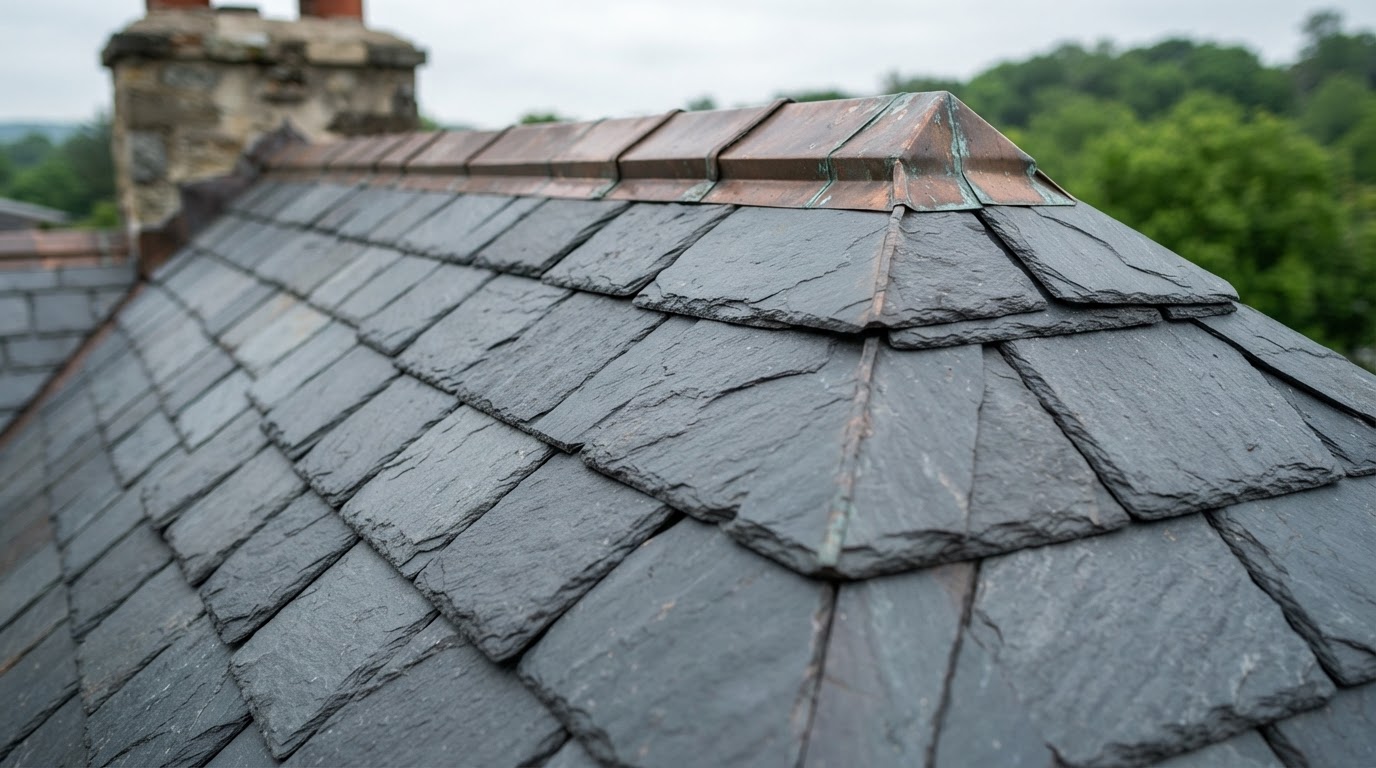
Signs of Slate Roof Damage Near Montgomery
Slate roofs fail in specific ways. The visible signs usually point to individual units, fasteners, or flashing rather than the whole roof — and several components can be involved at once.
Cracked and Broken Slate
Individual slate units can crack or break from impact, foot traffic, or material stress. A broken unit exposes the fastener and the underlayment beneath.
Missing or Displaced Units
Slate that has slipped or fallen away leaves the roof plane open. The cause is often a failed fastener or the nail hole in the slate itself.
Fastener Deterioration
The nails or hooks that hold each slate unit can corrode over time. When the fastener fails, sound slate can still slip — the problem is the attachment, not the stone.
Flashing Leaks
Valleys, chimneys, walls, and penetrations rely on metal flashing. Deteriorated flashing is a common leak source on an otherwise sound slate roof.
Ridge and Valley Deterioration
Ridge units and valley details weather differently from the field slate and may need attention while the main roof remains serviceable.
Previous Improper Repairs
Past repairs with incompatible materials — tar, mismatched slate, or wrong fasteners — can trap moisture or fail early and may need to be corrected.
Visible roof problems can involve several components at once, and the repair scope follows what the assessment finds. Age alone does not mean a natural slate roof must be replaced — serviceable slate with failed fasteners or flashing may be repairable.
Evaluating Slate Roof Repairs in Montgomery
Evaluating a slate roof starts with confirming the material and then reviewing the components that fail. Slate is brittle, and the way the roof is accessed matters as much as the repair itself.
Identify natural versus manufactured slate
Natural stone versus synthetic or manufactured slate — they repair differently.
Review visible damage
Cracked, broken, missing, or displaced units.
Evaluate individual slate units
Soundness of the stone beyond the visible break.
Examine flashing
Valleys, chimneys, walls, and penetrations.
Consider fastener condition
The nails or hooks holding each unit, where accessible.
Check accessible roof components
Areas that can be reached without damaging the slate.
Review previous repair methods
Whether prior work used compatible materials.
Match replacement material
Color, thickness, and origin of any replacement slate.
Assess roof access and safety
How to reach the roof without cracking sound slate underfoot.
Slate can be damaged by inappropriate foot traffic. Homeowners should not walk on a slate roof to inspect or photograph it — ground-level observation or a qualified assessment is safer than climbing onto a brittle stone surface.
Slate Roof Repair Options for Montgomery Homes
Individual Slate Replacement
Replacing broken or missing units with compatible slate — matched in color, thickness, and origin — and re-fastening with appropriate hooks or nails. Dimensions and attachment must suit the existing assembly.
Flashing Repairs
Reworking valleys, chimneys, walls, and penetrations with appropriate metal flashing that suits the slate roof and the detail.
Fastener and Attachment Issues
Repairs must respect the existing slate assembly. Failed fasteners can be addressed where the slate allows, without removing sound units unnecessarily.
Historic Roof Considerations
Where a slate roof is part of a historic property, matching materials and preserving architectural character can matter. This page does not claim historic preservation certifications.
Slate Roof Repair vs. Replacement
Localized deterioration — a few broken units, failed flashing, or slipped slate — can often be repaired. Widespread slate failure, soft or delaminating stone, or failed fasteners across the roof may point to replacement. An assessment distinguishes a repairable roof from one that has reached the end of its serviceable life.
Slate Roof Repair Questions for Montgomery Homes
Can individual broken slate tiles be replaced?
Yes, when the surrounding slate and the fasteners are sound. A broken unit can be removed and replaced with compatible slate matched in color, thickness, and origin, re-fastened to suit the assembly.
Why do slate roofs develop leaks?
Common causes are failed fasteners, broken or missing units, and deteriorated flashing at valleys, chimneys, and penetrations. The stone itself often remains sound; the leak is usually in the attachment or the metalwork.
Can old slate roofing be repaired?
Often, yes. Serviceable slate with failed fasteners or flashing may be repairable. Whether repair is reasonable depends on the condition of the stone and the attachment across the roof, not on age alone.
How are replacement slate materials matched?
Replacement slate is matched in color, thickness, texture, and origin to the existing roof so the repair reads as part of the original. An exact match is not always possible, and the aim is a compatible, respectful repair.
What causes slate tiles to loosen?
Fastener failure is a common cause — the nail or hook corrodes or the nail hole in the slate widens. Impact, freeze-thaw, and prior improper repairs can also loosen units.
Can flashing repairs preserve an existing slate roof?
Yes. Deteriorated flashing at a valley, chimney, or wall is a frequent leak source on an otherwise sound slate roof. Reworking the flashing can extend the roof's serviceable life without replacing the slate.
When might slate roof replacement become necessary?
When the slate itself is failing broadly — soft, delaminating, or broken across many areas — or when fasteners have failed throughout the roof. An assessment distinguishes a roof that can be repaired from one that has reached the end of its serviceable life.
Questions About an Existing Slate Roof Near Montgomery?
Describe the slate roof, the age if known, and where the concern appears. The right next step — repair, selective replacement, or full reroof — follows the condition of the stone, the fasteners, and the flashing, not a single visible crack.