
Shingle, Metal & Commercial Roofing Tallassee
Tallassee is one community that extends across two counties — Elmore and Tallapoosa — so the exact parcel matters when permitting comes up. This page gives stronger weight to commercial roofing than smaller residential-oriented communities: TPO and low-slope membrane evaluation, commercial roof drainage and penetrations, and coordinating work around occupied businesses — alongside shingle repair and replacement, standing-seam and exposed-fastener metal, and flashing detail work for homes. The Tallapoosa River setting is accurate geography, but it does not make every property riverfront, flood-prone, or subject to the same conditions. The City of Tallassee Building Department's requirements are verified for the specific parcel; the City of Montgomery's rules are not borrowed.
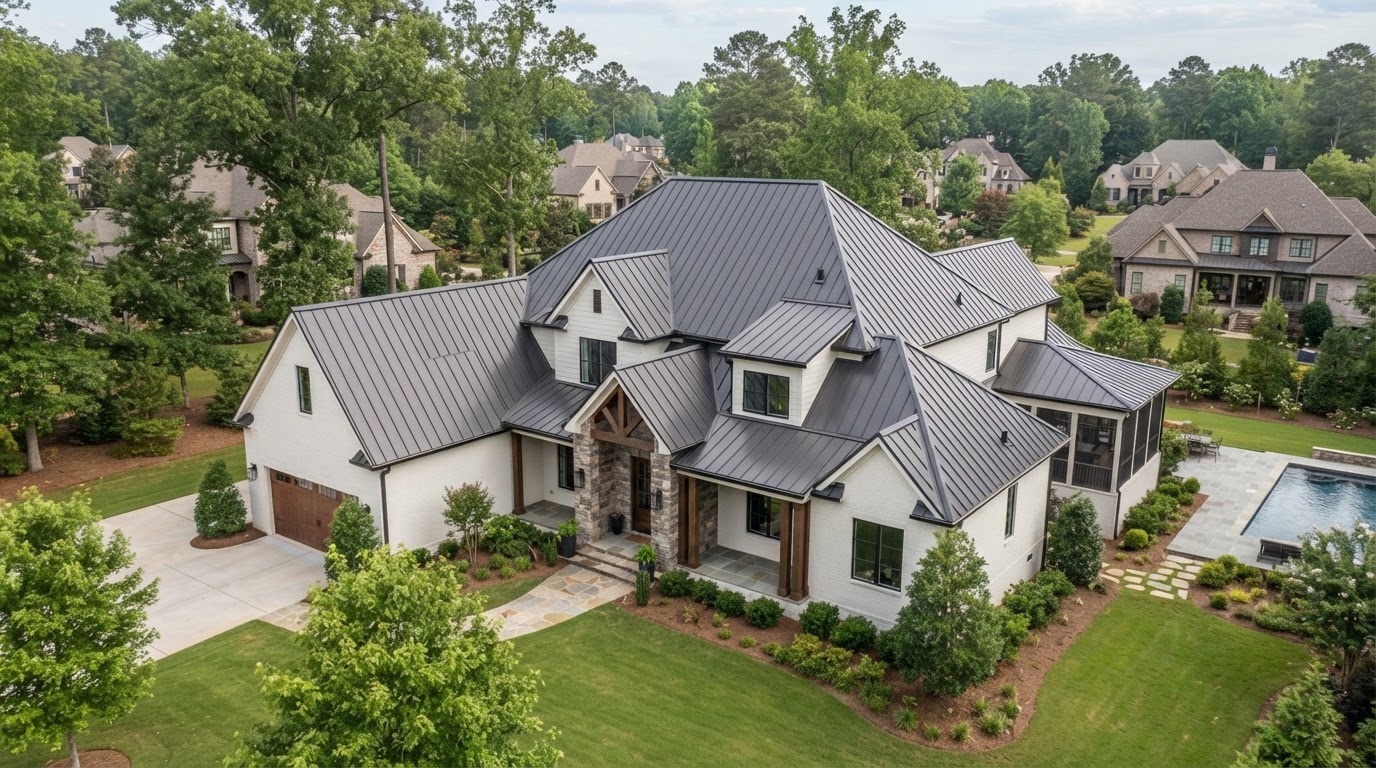
Residential Roof Repair and Replacement in Tallassee
Shingle repair and replacement, standing-seam and exposed-fastener metal, commercial TPO and low-slope systems, drainage and penetrations, and inspections.
Shingle Repair & Replacement
A full re-roof evaluates existing layers, decking, underlayment, flashing, valleys, and ventilation before a new shingle system is installed.
Learn moreStanding-Seam Metal Roofing
Concealed-fastener standing seam selected against roof slope, style, and compatibility with the existing assembly.
Learn moreExposed-Fastener Metal Repair
Through-fastened panels need washer, fastener, and seal inspection as they age — evaluated separately from standing seam.
Learn moreRoof Leak Investigation
Leak assessment separates the visible interior evidence from the likely exterior source rather than diagnosing from a stain alone.
Learn moreCommercial TPO Roofing
Low-slope commercial buildings may call for TPO or other membrane systems, evaluated against the building and confirmed scope.
Learn moreCommercial Roof Repair
Commercial repairs address membrane seams, drainage, penetrations, and rooftop equipment specific to the building.
Learn moreRoof Inspections
A documented condition assessment supports repair, replacement, or maintenance decisions for the specific roof.
Learn moreStorm Damage Assessment
Post-storm documentation supports the owner's insurance process without promising claim approval or deductible reimbursement.
Learn moreCommercial TPO Roofing and Roof Repairs in Tallassee
Commercial roof decisions differ from residential roofing — membrane condition, seams, penetrations, drainage, and occupancy all require system-specific evaluation.
Commercial roofing and residential roofing are not the same work. A low-slope commercial roof is evaluated for the membrane, seams, penetrations, rooftop equipment curbs, drains or scuppers, flashing, and any ponding or previous repairs. The actual source of a commercial leak is identified before any repair is prescribed — a drip near a rooftop unit is not the same as a seam defect. Drainage and slope are addressed as the specific building requires, not from a universal specification, and occupied facilities are coordinated around normal operations without promising zero business disruption.
Tallassee's Tallapoosa River setting is accurate geographic context, but it does not make every property riverfront or flood-prone. No property is assigned a flood-zone or environmental condition without a verified address and the applicable official mapping. On the residential side, shingle repair and replacement, metal system selection, and flashing detail work follow what the specific roof shows — the covering, the valleys and intersections, the penetrations, and the drainage that moves water off the roof.
Commercial and residential are different scopes
Commercial Roof Drainage and Membrane Problems Near Tallassee
Identifying the actual source before repairs — on a low-slope commercial roof, the visible drip is not always the entry point.
1. Evaluate the Roof System
On-site review of the covering, flashing, penetrations, valleys, drainage, and accessible interior evidence for the specific property.
2. Separate Roof from Site Drainage
Roof-water entry is distinguished from gutter, downspout, foundation, or wider drainage concerns before a scope is developed.
3. Identify the Actual Source
On a low-slope commercial roof, the visible drip is traced to the likely entry point — seam, penetration, drain, or ponding — rather than assumed.
4. Weigh Repair and Replacement
A localized defect may be repairable; widespread membrane deterioration, repeated leaks, or concealed moisture may favor replacement.
5. Develop the Scope
A written scope reflecting the actual findings — including any commercial membrane or drainage work — rather than a generic package.
6. Approvals, Work, Closeout
Permit and jurisdiction verified for the parcel; work performed in keeping with the agreed scope, followed by cleanup and maintenance guidance.
Roofing Project Planning Across Local Jurisdictions
Tallassee spans Elmore and Tallapoosa counties — the exact parcel location matters, and current permit and approval requirements are confirmed through the City of Tallassee Building Department.
Tallassee extends across Elmore and Tallapoosa counties, so the exact parcel location matters when permitting comes up. The City of Tallassee Building Department governs projects within its jurisdiction; whether a roofing project requires a permit, inspection, or plan submittal depends on the scope and the specific property — and, where relevant, any property-specific historic or flood-related requirements confirmed through official sources. The City of Montgomery's published like-for-like guidance is not automatically applied to a Tallassee address. Before stating any permit rule as definite, the actual authority for the parcel is confirmed against current City of Tallassee resources.
No older Tallassee building is assumed to be historically regulated, and no property is assigned a flood-zone or riverfront condition without a verified address and the applicable official mapping. Commercial projects add their own considerations: occupied buildings, customer and employee access, rooftop equipment coordination, material staging, parking, and scheduling that limits disruption without promising zero interruption to business operations. Whether a property lies within the City of Tallassee or a different applicable jurisdiction is verified before any building department is assumed.
Residential and Commercial Roofing Considerations in Tallassee
Roofing systems for different buildings, drainage and leak prevention, and weighing repairs against replacement for Tallassee properties.
Roofing Systems for Different Buildings
Tallassee includes a range of building types, so the roofing system is matched to the structure rather than assumed from the community. Asphalt shingles suit many steep-slope residences; metal roofing — standing-seam or exposed-fastener, each evaluated for its own fastening and maintenance — is considered where the slope, style, and owner preference fit. Appropriate low-slope commercial systems, including TPO and other membranes, are evaluated for qualifying low-slope buildings, and the assessment addresses the membrane, seams, drains, and rooftop equipment rather than the steep-slope shingle methods used on a residence. The recommendation follows the building that is actually there. The commercial roofing overview explains how those systems differ.
Roof Drainage and Leak Prevention
Water management is what keeps a covering performing. On a residential roof, flashing at valleys and penetrations, gutters and downspouts at the roof edge, and the roof's slope determine how quickly water moves off the surface. On a low-slope commercial roof, membrane seams, drains or scuppers, and penetration flashing carry that load, and a leak near a rooftop unit is not the same as a seam defect — the actual source is identified before any repair is prescribed. Drainage and slope are addressed as the specific building requires, not from a universal specification, and the Tallapoosa River setting is accurate geography rather than a flood-zone or riverfront condition assigned to every property.
Evaluating Repairs Versus Replacement
Whether a Tallassee roof is repaired or replaced follows what an on-site assessment actually finds. A localized defect with sound surrounding material may be repairable, while recurring leaks in separate areas, widespread material deterioration, soft decking, or multiple existing layers often favor replacement. Material condition, the extent of deterioration, and the building's design all weigh into the recommendation rather than a fixed rule. Because Tallassee extends across Elmore and Tallapoosa counties, the property-specific permitting and jurisdiction is verified by address through the City of Tallassee Building Department before any requirement is stated as definite — not every building is historic, commercial, or industrial, and not every property shares the same authority. The roof replacement page outlines how that decision is built.
Roofing Questions About Tallassee
Local questions on repair versus replacement, metal suitability, commercial TPO, drainage, occupied-building scheduling, and cross-county jurisdiction.
When is shingle repair enough, and when does a Tallassee roof need full replacement?
A localized defect — a few damaged shingles or one flashing leak — may be repairable when the surrounding material is sound and compatible. Widespread shingle deterioration, repeated leaks across several areas, soft decking, or multiple existing layers often favor replacement. The decision follows what an on-site assessment of the specific roof actually shows, not a fixed rule or an assumption from the address.
Is a standing-seam metal roof suitable for my Tallassee home?
Standing seam is durable where the roof's slope and style suit it and the owner prefers the look. Concealed clips and a continuous folded seam hide the fasteners and allow thermal movement. Metal is not noise-free or maintenance-free, and exposed-fastener panels are a separate system with their own fastener and washer upkeep. The recommendation follows the actual roof and the owner's goals — not a universal preference.
How do I identify a possible roof leak source?
A stain on an interior ceiling rarely maps directly to the entry point above it, because water can travel along framing before it appears inside. Leak assessment distinguishes the visible interior evidence from the likely exterior source — a chimney, valley, pipe-boot, or roof-to-wall transition — rather than diagnosing from a stain alone. On a low-slope commercial roof, the visible drip is traced to the likely entry point rather than assumed.
What does a commercial TPO roof inspection involve?
A low-slope commercial inspection looks at the membrane, seams, penetrations, rooftop equipment curbs, drains or scuppers, flashing, and any ponding or previous repairs. The goal is to identify the actual source of a concern — a leak at a rooftop unit is not the same as a seam defect — so the scope reflects the building rather than a generic repair. Drainage and slope are addressed as the specific building requires.
What about ponding water and roof drainage on a commercial roof?
Ponding is evaluated against the roof's structure, drains or scuppers, and the membrane condition. Persistent ponding can shorten a membrane's service life and may point to a drainage, slope, or structural issue rather than a covering defect alone. The actual source is identified before any repair is prescribed, and drainage is addressed as the specific building requires — not from a universal specification.
How are flashing problems around commercial penetrations repaired?
Penetration flashing — around rooftop units, pipes, and curbs — is detail work where many commercial leaks originate. A repair addresses the specific transition rather than coating the whole roof, and caulk is not a universal durable fix. The flashing is evaluated against the roof system and the material involved, and a properly detailed repair is weighed against replacement where the flashing is deteriorated or incompatible.
How is roofing work scheduled around an occupied Tallassee business?
Occupied commercial facilities are coordinated around normal operations — customer and employee access, rooftop equipment, material staging, parking, and scheduling that limits disruption. The goal is to reduce interruption without promising zero business disruption, and access constraints are noted up front so the responding provider can plan safely. Residential and commercial scopes are coordinated differently because the buildings and their occupants differ.
How do I confirm the right permit authority for a Tallassee property?
Tallassee extends across Elmore and Tallapoosa counties, so the exact parcel matters. The City of Tallassee Building Department governs projects within its jurisdiction; whether a project needs a permit or inspection depends on the scope and the specific property, and any property-specific historic or flood-related requirements are confirmed through official sources. The City of Montgomery's like-for-like guidance is not automatically applied to a Tallassee address — the actual authority for the parcel is verified before any permit rule is stated as definite.
Tallassee in the Region
An accurate municipal reference and related nearby service areas.
Tallassee is a city extending across Elmore and Tallapoosa counties, Alabama, along the Tallapoosa River. This page describes roofing considerations for properties in Tallassee — it does not represent a branch office inside the city, and the river setting is not applied to every property as riverfront or flood-prone. Eclectic and Wetumpka are separate nearby Elmore County communities and are not treated as the same location.
Regional coverage context only · city spanning two counties · not a contractor office or fabricated boundary
Request a Roofing Quote in Tallassee
Share the property location, the roofing concern, whether the property is residential or commercial, and any occupancy or access notes. An assessment documents the visible conditions, weighs repair against replacement, separates roof water from wider drainage concerns, and confirms the correct City of Tallassee jurisdiction for the specific parcel — including whether it falls in Elmore or Tallapoosa County.