
Residential Flat Roof Repair Montgomery
Roofs described as flat are almost always low-slope, and a low-slope roof needs a properly designed membrane assembly and drainage to perform. On homes these sections appear on additions, attached rooms, garages, certain porches, and other residential structures. This page covers how existing low-slope roof problems are evaluated and what repair options may apply — separate from porch and patio roof construction and from commercial flat roofing.
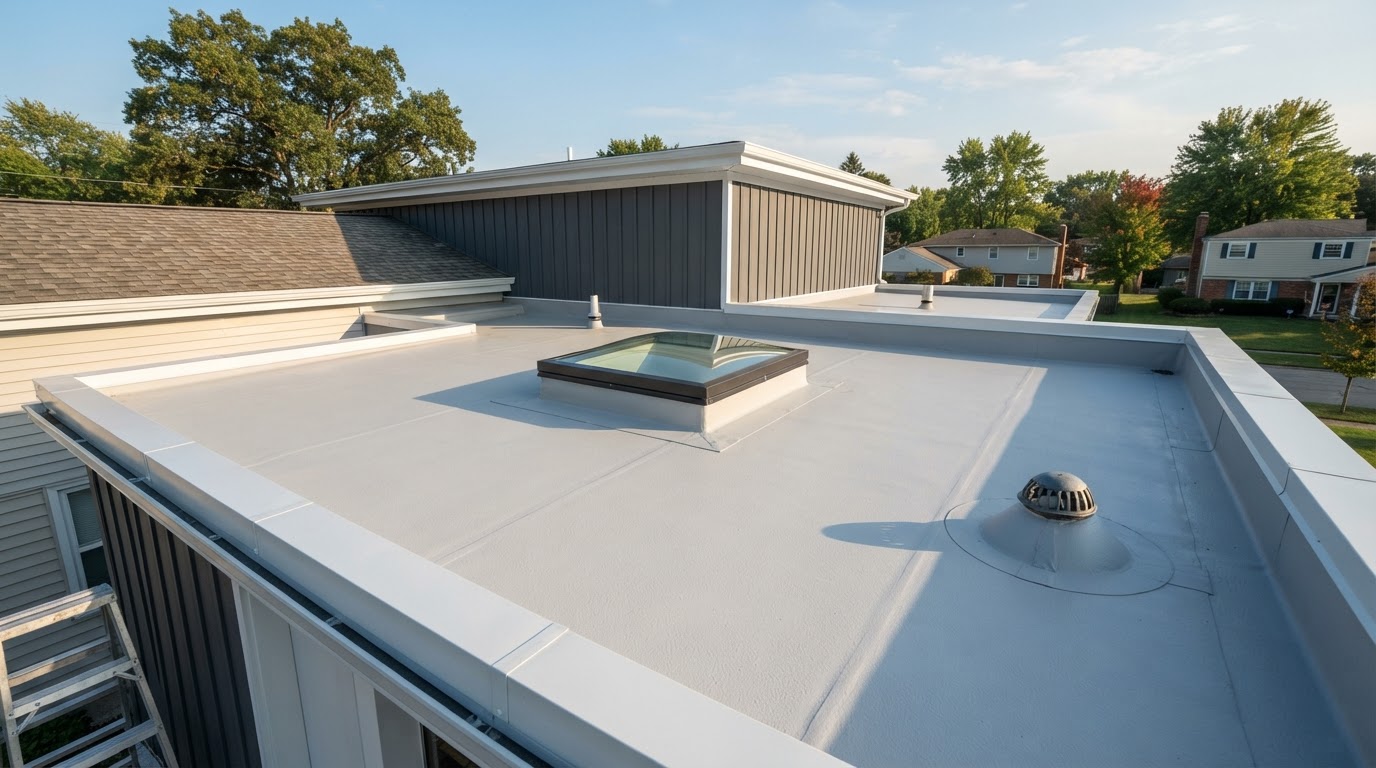
Flat Roof Problems That May Require Repair Near Montgomery
Membrane Punctures and Open Seams
Punctures from impact, foot traffic, or rooftop work, and seams that have opened, expose the substrate and allow water into the assembly.
Flashing Deterioration
Flashing at walls, curbs, penetrations, and edges weathers and separates from the membrane, creating common leak paths.
Roof Penetration Problems
Vents, drains, skylights, and mechanical penetrations are details where membrane and metal meet — and where leaks often start.
Ponding Water and Drainage Obstructions
Water that does not drain off a low-slope roof sits on the membrane. Ponding can accelerate membrane aging and stress the assembly; obstructed or undersized drains make it worse.
Edge Termination Problems
Where the membrane meets the edge metal, a failed termination can let wind and water lift or enter the assembly.
Weathered and Moisture-Affected Materials
An aged membrane or one that has taken on moisture in the substrate or insulation may need repair or replacement rather than a surface patch.
Water can travel within a low-slope assembly before it appears indoors, so an interior stain does not always mark the actual leak location. The entry point is found by reviewing the membrane and the details, not by the ceiling stain alone.
Evaluating Residential Low-Slope Roof Repairs in Montgomery
Evaluating a low-slope roof means identifying the existing system and then reviewing the components that fail on flat assemblies. The membrane, the seams, and the drainage are where the questions usually are.
Identify the existing system
EPDM, TPO, PVC, modified bitumen, or another assembly — each repairs differently.
Review membrane condition
Weathering, punctures, surface cracking, and the overall condition of the field membrane.
Check seams and laps
Whether the seams are bonded and intact or showing separation.
Evaluate penetrations
Drains, vents, skylights, and curbs and the flashing around them.
Review flashing
Wall, edge, and curb flashing and their terminations.
Assess drainage
Whether water leaves the roof or ponds, and the condition of drains and scuppers.
Consider insulation and substrate
Signs of wet insulation or a compromised deck beneath the membrane.
Evaluate moisture concerns
Whether the assembly has taken on water that a surface repair will not address.
Determine repair feasibility
Whether a localized repair is reasonable or membrane replacement is warranted.
Specialized investigations such as infrared moisture surveys are not automatically part of every assessment. Where concealed moisture is a concern, the method and its availability are confirmed rather than assumed.
Residential Flat Roof Repair Options Near Montgomery
EPDM
A thermoset rubber membrane common on residential low-slope sections. Repairs use compatible uncured flashing and adhesive specific to EPDM — not the same methods as a thermoplastic membrane.
TPO
A thermoplastic single-ply membrane whose seams are heat-welded. Repairs use compatible TPO membrane and heat-welding, not EPDM-style adhesives.
PVC
Another thermoplastic membrane with its own compatible materials and welding requirements. PVC and TPO are not interchangeable despite both being thermoplastic.
Modified Bitumen
A multi-ply or modified-bitumen assembly surfaced with granules or coating, common on older residential low-slope roofs. Repairs use compatible modified-bitumen materials and methods.
Other Existing Low-Slope Systems
Some roofs are built-up, coated, or assembled with materials that must be identified before a repair method is selected. The repair follows the existing system.
Drainage and Ponding Water on Residential Flat Roofs
A low-slope roof has to drain. Ponding water stresses the membrane, ages it faster, and can indicate a drainage or slope problem. Where drainage is the issue, a repair that ignores it will not hold — the cause has to be addressed along with the membrane.
Can Roof Coatings Fix a Leaking Flat Roof?
A coating may be appropriate for some evaluated, sound assemblies as maintenance or to extend surface life. A coating does not correct structural deterioration, wet insulation, failed seams, or every leak. Suitability follows the condition of the existing roof — a coating is not a universal repair.
Residential Flat Roof Repair Questions for Montgomery Homes
Can a residential flat roof be repaired?
Often, yes. A localized membrane puncture, an open seam, or failed flashing can be repaired when the surrounding assembly is sound. Repairability depends on the membrane condition, drainage, and whether the substrate or insulation has taken on moisture.
What causes leaks on low-slope roofs?
Open seams, punctures, failed flashing at walls and penetrations, obstructed or undersized drains, and ponding water. Because water can travel within the assembly, the visible interior stain is not always the entry point.
What is the difference between TPO and EPDM?
TPO is a thermoplastic membrane with heat-welded seams; EPDM is a thermoset rubber membrane repaired with compatible uncured flashing and adhesive. They use different materials and methods and are not interchangeable.
Is standing water a concern on a flat roof?
Yes. A low-slope roof should drain. Ponding water stresses the membrane, accelerates aging, and can point to a drainage or slope problem. A repair that ignores drainage will not perform — the cause and the membrane both need attention.
Can a coating stop flat roof leaks?
A coating can suit some sound, evaluated assemblies as maintenance or surface extension. It does not fix structural deterioration, wet insulation, or failed seams. Suitability depends on the existing roof's condition, not on the coating alone.
When is a membrane replacement necessary?
When the membrane is failing broadly, the insulation is wet, seams are failing across the roof, or drainage problems have damaged the assembly. An evaluation distinguishes a roof that can be repaired from one that needs replacement.
How do flashing and penetrations affect flat roof repairs?
Walls, curbs, drains, vents, and skylights are where most low-slope leaks start. Repairs have to address the flashing and penetration details, not just the field membrane, or the leak can return at the same detail.
Need a Residential Flat Roof Assessment Near Montgomery?
Share the low-slope roof section, the membrane type if known, and where the leak or drainage concern appears. The right repair — or replacement — follows the existing system, the drainage, and the assembly's condition, not a surface patch alone.