Leaking Metal Roof Screws in Montgomery
On a through-fastened metal roof, the sealing washer under each screw is the primary weather seal — and over years of sun and temperature cycling, those washers harden, crack, or compress and let water past the fastener. This guide explains why exposed-fastener metal roofs leak at the screws and what repair options may apply, separate from standing-seam systems.
Exposed-Fastener Metal Roofing and Fastener Condition
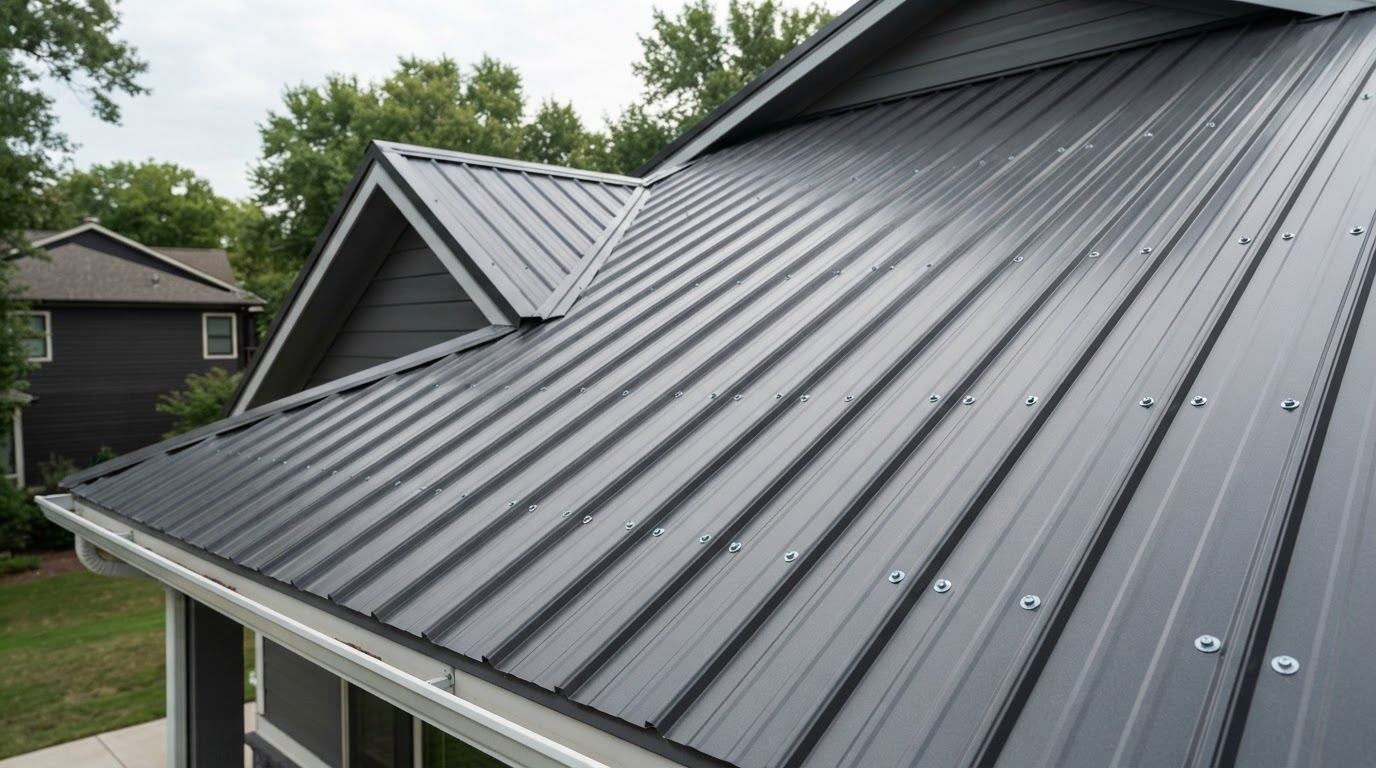
On a through-fastened roof, the screws and their washers are the weather seal.
Exposed-fastener (through-fastened) metal roofs hold the panels down with screws that penetrate the visible panel face, each sealed by a rubber or EPDM washer under the screw head. That washer is doing the weatherproofing work. Over years of ultraviolet exposure, heat, and freeze-thaw cycling, the washer hardens, cracks, or compresses and loses its seal — and water begins to move past the fastener.
Not every metal roof has exposed screws. Standing-seam systems use concealed clips and do not rely on through-fasteners in the panel face, so they do not develop this specific condition. This page is about exposed-fastener systems. And not every leak on an exposed-fastener roof originates at a fastener — seams, laps, flashing, and penetrations can also be the source. An assessment determines which.
The washer is the wear item
Why Exposed Fasteners Develop Problems
Several mechanisms age a through-fastened roof — rarely just one.
Aging or deteriorated sealing washers
The rubber or EPDM washer under each screw head compresses, hardens, or cracks over years of sun and weather exposure, losing its seal.
Loose or backed-out screws
Thermal expansion and contraction can work screws loose over time, lifting the washer away from the panel and opening a path for water.
Incorrect installation or tightening
Screws driven at the wrong angle, over-tightened (crushing the washer), or under-tightened (no compression) fail to seal from the start.
Corroded fasteners
Screws that lose their protective coating can rust, weakening the fastener and staining the panel around the head.
Enlarged or damaged fastening holes
Years of panel movement can wallow out the screw hole, so the fastener no longer bears tightly against the panel.
Panel movement and thermal expansion
Metal expands and contracts with temperature; without proper accommodation, that movement stresses fasteners and washers repeatedly.
Substrate deterioration
When the decking or purlins beneath a fastener soften from moisture, the screw loses its solid anchor and can pull or leak.
Incompatible fasteners or dissimilar-metal corrosion
Using a fastener metal incompatible with the panel can cause galvanic corrosion at the contact point, accelerating failure.
Incorrectly detailed laps and penetrations
Fastener problems at panel laps and around penetrations are often tied to how those transitions were originally detailed.
These are general mechanisms of fastener aging, not a claim about specific Montgomery damage histories. How fast a given roof's fasteners age depends on the product, installation, orientation, and exposure.
Signs of Possible Fastener-Related Leakage
Observable indicators worth an assessment — not a definitive diagnosis.
These observations warrant an assessment — they are not a definitive diagnosis. Rust at a screw head, for example, can indicate a fastener problem or a panel-coating issue, and interior staining can originate at a seam rather than a fastener.
Possible Repair Methods
The repair has to match the panel system — there is no universal screw.
Depending on the panel manufacturer and roof condition, repair may include replacing failed fasteners with compatible products, assessing damaged fastening locations, correcting inappropriate fastener placement or installation, addressing corroded panels or damaged substrates, repairing associated flashing or seam defects, and replacing affected panels when localized repair is inadequate.
We do not recommend simply installing larger screws everywhere. Fastener size, material, washer construction, spacing, torque, and attachment requirements depend on the roofing system and manufacturer. Oversizing a screw as a default fix can damage the panel and does not address the underlying washer or substrate condition.
Indiscriminate sealant over every screw head is not a permanent repair. Smearing sealant across the roof as a blanket fix traps moisture, hides the actual fastener condition, and fails as the sealant ages. Proper repair addresses the fastener and washer, not just the surface above them.
When Screw Replacement Is Not Enough
Sometimes the fasteners are a symptom of a broader roof-system condition.
Widespread corrosion, panel deterioration, repeated leakage despite fastener repairs, improper original installation, or compromised support conditions can all mean the roof needs more than new screws. In those cases a broader repair, a restoration, a retrofit, or a full replacement may be the appropriate scope. The distinction matters: replacing fasteners is maintenance on an otherwise sound system, while rebuilding a failing assembly is a different project entirely.
An assessment helps tell the two apart. When the panels and substrate are sound and only the fasteners have aged, targeted replacement can extend the roof's service. When the panels, coating, or support structure are failing, fastener replacement alone will not solve the leak for long.
Frequently Asked Questions About Leaking Metal Roof Screws
Clear answers about washers, replacement, coatings, and when the problem is bigger.
01.Why do metal roof screws start leaking?
On an exposed-fastener metal roof, the sealing washer under each screw head is the primary weather seal. Over years of sun, temperature cycling, and weather, that washer can harden, crack, or compress and lose its seal. Screws can also back out from thermal movement, corrode, or sit in enlarged holes. Any of those lets water past the fastener. The leak is usually a fastener-and-washer condition rather than a problem with the panel itself.
02.Can deteriorated screw washers be replaced?
Yes — replacing failed fasteners with compatible screws and new sealing washers is a common repair when the panels and substrate are still sound. The replacement fastener has to match the panel system's requirements for size, material, washer construction, and spacing. We do not recommend a universal screw size or type; the right component depends on the roofing system and manufacturer.
03.Is tightening loose roof screws enough?
Not usually. A screw that has backed out may re-seal temporarily when re-tightened, but if the washer has already hardened or cracked, tightening alone does not restore the seal. Re-tightening can also crush an already-failed washer further. The washer and often the screw itself need to be evaluated, not just snugged down.
04.Can rusted screws damage metal panels?
They can. A corroded fastener can stain the panel around the head, and the rust can spread to the protective coating of the panel at the contact point. In dissimilar-metal situations, galvanic corrosion can accelerate damage to both the fastener and the panel. Rusted screws are a sign the fastener has reached the end of its service life and should be evaluated for replacement.
05.Should every screw be replaced at once?
Not necessarily. When only a portion of the fasteners have failed, targeted replacement of the affected screws may be appropriate. When leakage is widespread, washers are broadly aged, or corrosion is extensive, a broader fastener replacement or a larger roof-system repair may make more sense. The scope should follow what an assessment finds, not a default assumption that every screw must go at once.
06.Do standing seam metal roofs have the same issue?
No — standing-seam systems use concealed clip fasteners and do not rely on through-fasteners penetrating the exposed panel face, so they do not develop the same exposed-screw washer wear. This page specifically addresses exposed-fastener (through-fastened) metal roofing. Standing-seam roofs have their own distinct maintenance considerations.
07.Can a roof coating solve leaking screws?
A coating is not a substitute for correcting failed fasteners. Applying a coating over leaking screws without addressing the washer, fastener, and hole condition can trap moisture and does not restore the mechanical seal the fastener is supposed to provide. Where a coating is appropriate, it follows — it does not replace — proper fastener repair.
08.When does fastener leakage indicate a bigger roofing problem?
When leakage is widespread, when panels are corroding, when the substrate or purlins beneath fasteners have deteriorated, when the original installation was improper, or when repeated repairs do not hold, the issue may extend beyond individual screws. In those cases a broader repair, restoration, retrofit, or replacement may be warranted. An assessment determines whether the problem is isolated to fasteners or part of a larger roof-system condition.
Related Roofing Resources
Continue exploring metal roof repair and restoration topics:
Request a Metal Roof Leak Assessment
If your exposed-fastener metal roof is leaking, an on-site assessment can determine whether the source is aged washers, loose or corroded fasteners, damaged panels, or a broader roof-system condition — and outline repair options that match your panel system rather than a blanket fix.