
Rusted Metal Roof Restoration Montgomery
A rusty metal roof is not automatically a failed roof — but it is not automatically a coating candidate either. The central question is whether the corrosion is manageable surface oxidation the panel can recover from, or section loss that has compromised the metal. This guide explains how that distinction is made and what restoration or replacement options may apply.
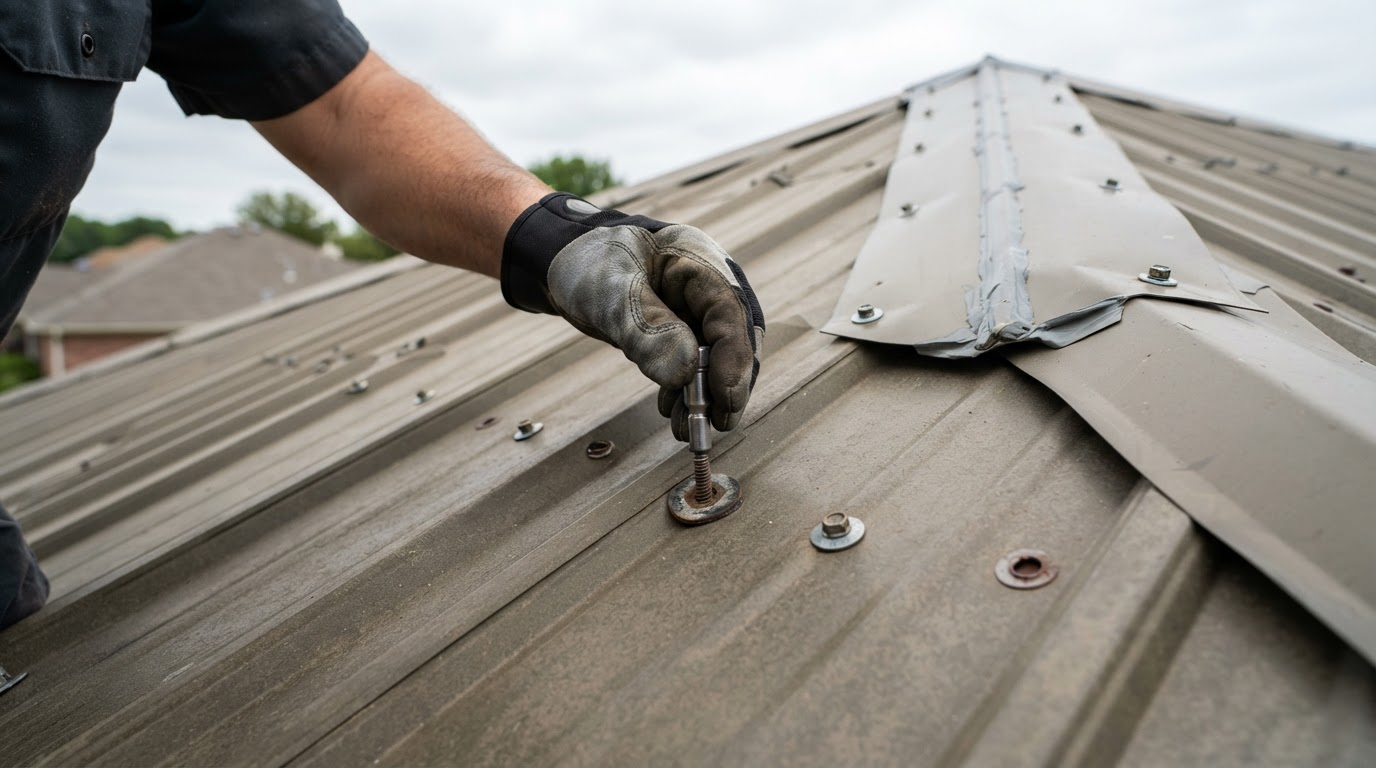
Can the Roof Be Restored, or Has Corrosion Gone Too Far?
The answer depends on the metal, the coating, the extent of corrosion, and the panel's integrity.
A metal roof showing rust is not necessarily at the end of its life. Many metal roofs develop surface oxidation or coating breakdown long before the panel itself is compromised, and a well-executed restoration can extend service when the metal beneath the corrosion is still sound. The question that matters is how far the corrosion has progressed into the panel.
That answer depends on the type of metal, the original coating system, the extent and pattern of the corrosion, the integrity of the panels, the attachment, and the overall condition of the roof. Restoration is appropriate in some cases and the wrong choice in others — and the difference is not visible from a photograph. It requires evaluating the actual roof.
Rust is a spectrum, not a verdict
Common Corrosion Patterns
Where and how rust appears tells you a lot about whether restoration fits.
Surface rust
Light oxidation on the coating or exposed metal that has not yet thinned the panel — often the most manageable condition.
Corrosion at scratches or exposed edges
Rust beginning at a scratch, cut edge, or fastener hole where the protective coating was breached.
Deteriorating protective finishes
The original paint or coating is chalking, peeling, or breaking down, exposing the underlying metal across broader areas.
Rust around fasteners and penetrations
Corrosion concentrated at screw heads, washers, and penetration flashing where coating damage and moisture collect.
Corrosion at panel laps
Rust developing where panels overlap, often tied to moisture trapped in the lap or dissimilar-metal contact.
Rust associated with trapped moisture
Corrosion driven by moisture held against the panel — from debris, poor drainage, or a covering layer.
Corrosion of accessories and attachment components
Rust on flashing, trim, closures, or fasteners that can compromise weatherproofing even when panels are intact.
Severe section loss or panel perforation
Corrosion advanced enough to thin or perforate the panel — typically beyond restoration and into replacement territory.
Rust does not always mean an entire metal roof has failed. Surface oxidation on an otherwise sound panel is a very different condition from perforation that has eaten through the metal — and they call for opposite responses.
Assessment Before Restoration
Restoration only makes sense if the metal beneath the rust is still sound.
Structural weakness requires a qualified professional. If the corrosion appears to have compromised the panel's structural capacity or the support beneath it, evaluation by an appropriately qualified professional is needed before any restoration is planned. A coating is not a structural repair.
Potential Restoration Approaches
Condition-dependent options — not a universal recipe.
When the assessment supports restoration, the approach depends on the condition found. It may include appropriate cleaning, rust removal or surface preparation, compatible primers, manufacturer-approved protective coating systems, fastener or flashing replacement, localized panel replacement, and correcting drainage or moisture-trapping conditions that drove the corrosion in the first place.
Preparation and compatibility are not universal. We do not prescribe abrasive blasting, specific chemical treatments, a coating thickness, or a particular system for every roof. Surface preparation and product compatibility depend on the substrate, the corrosion, the manufacturer's requirements, and the application conditions. The product documentation governs.
Restoration Versus Replacement
A coating cannot restore lost metal or fix concealed deterioration.
Severe corrosion, holes, failing attachments, widespread substrate deterioration, or incompatible assemblies can require substantial replacement rather than coating. A coating cannot restore lost structural metal, and it cannot guarantee that wet insulation or concealed deterioration beneath the panels has been corrected. Coating over those conditions hides the problem and often fails.
A restoration can improve appearance and add a protective surface, but we do not promise a specific service-life extension from any restoration. How long a restored roof performs depends on the underlying condition, the preparation, the product, and ongoing maintenance. The honest framing is that restoration extends service when the metal is sound — it is not a way to avoid replacement once the metal is compromised.
Frequently Asked Questions About Rusted Metal Roof Restoration
Clear answers about surface rust, coatings, panel replacement, and when restoration is not enough.
01.Can a rusty metal roof be repaired?
Often, yes — when the corrosion is limited to the surface or to specific areas and the panels retain their integrity, restoration through cleaning, surface preparation, compatible primers, and manufacturer-approved coating systems can extend the roof's service. The decision depends on the metal, the coating system, the extent of corrosion, and the panel's structural condition. Not every rusty roof is a candidate; an assessment determines whether restoration is appropriate or replacement is necessary.
02.Is surface rust different from structural corrosion?
Yes, and the distinction is the whole point of a restoration assessment. Surface rust is oxidation on the coating or exposed metal that has not thinned the panel — it can often be treated. Structural corrosion is section loss or perforation that has compromised the panel's integrity — it cannot be coated away. A restoration only makes sense when the metal beneath the corrosion is still sound.
03.Can metal roofing be painted or coated?
Yes, when the right surface preparation and a coating system compatible with the substrate are used, and when the panel is structurally sound. The coating has to be approved for the specific metal and condition, and the surface has to be prepared according to the manufacturer's requirements. We do not prescribe a specific coating system or thickness universally — those depend on the substrate, the corrosion, and the product documentation.
04.Does coating stop every metal roof leak?
No. A coating addresses surface corrosion and can restore a weather-resistant surface, but it does not repair failed fasteners, damaged flashing, failed seams, or structural deterioration. If a leak originates at a fastener, penetration, or transition, the coating alone will not stop it — the underlying condition has to be corrected. A coating is one tool in a restoration, not a universal leak fix.
05.When should a corroded panel be replaced?
When corrosion has caused section loss, perforation, or structural weakness in the panel, replacement of the affected panel is appropriate rather than coating over it. A coating cannot restore lost structural metal. The line between restorable and replaceable is exactly what an assessment evaluates — panel thickness and integrity, extent of corrosion, and whether the metal beneath the rust is still sound.
06.Can rusted roof screws be replaced separately?
Yes. Fastener and flashing corrosion can often be addressed as part of a restoration by replacing the corroded components with compatible products, separate from any panel coating work. On an exposed-fastener roof, the screws and washers are wear items that may need replacement even when the panels are restorable. See our leaking metal roof screws page for more on fastener-specific issues.
07.How does water trapped at seams affect corrosion?
Moisture held in a panel lap — from debris, poor drainage, or capillary action — keeps the metal wet and accelerates corrosion exactly where panels overlap. Trapped moisture can also drive dissimilar-metal corrosion at the lap. Correcting the drainage or debris condition is part of a durable restoration; coating over a lap that still traps water will not hold.
08.When is a complete metal roof replacement preferable?
When corrosion is widespread, when panels are perforated or have significant section loss, when attachments are failing, when the substrate is deteriorated, or when the existing assembly is incompatible with restoration products, a full replacement is usually the better decision than repeated restoration attempts. A coating cannot restore lost structural metal or guarantee that wet insulation and concealed deterioration have been corrected.
Related Roofing Resources
Continue exploring metal roof repair and replacement topics:
Request a Metal Roof Restoration Assessment
If your metal roof is showing rust, an on-site assessment can determine whether the corrosion is restorable surface oxidation or section loss that calls for panel replacement — and outline a restoration or replacement approach based on what the roof actually shows, not a default coating recommendation.