
Soft Spots on the Roof: Causes and Repair in Montgomery
A spongy, uneven, or depressed area on your roof usually points to the decking beneath the shingles — not the shingles themselves. This guide explains what may cause soft spots and why they should be evaluated professionally rather than tested on foot.
What Is a Soft Spot on a Roof?
A localized area that has lost firmness usually signals a decking concern beneath the surface.
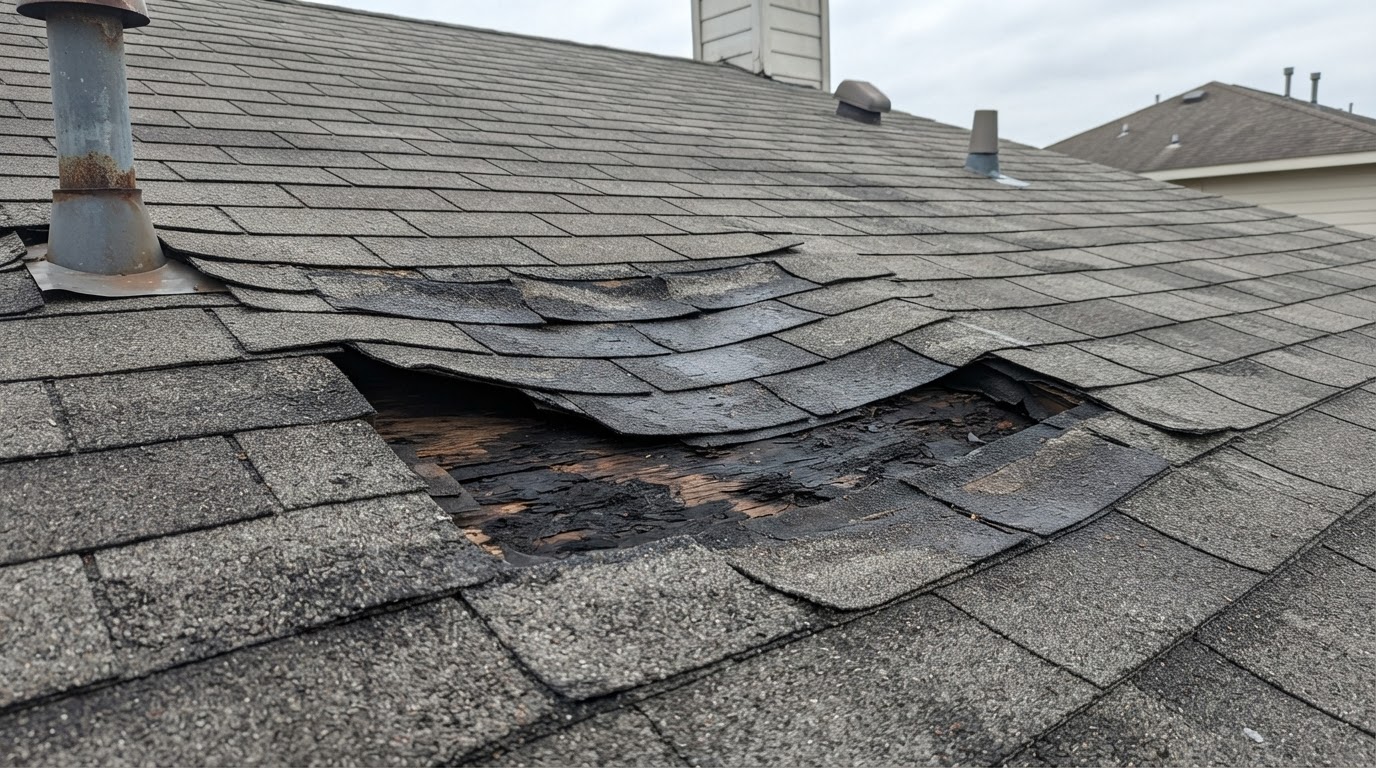
A soft spot is a localized area of the roof that is reported as soft, spongy, uneven, or visibly depressed compared with the surrounding surface. Homeowners sometimes notice it from the ground as a dip, or a roofing professional identifies it during an assessment as an area where the decking flexes more than it should. The shingles on top may look normal even when the sheathing beneath them has lost stiffness.
The actual condition cannot be established from appearance alone. A depressed area could be deteriorated decking, a localized framing issue, an incompatible prior patch, or simply decking that flexes because it was installed thin over wide rafter spacing. Each of these calls for a different response, which is why a soft spot should be evaluated rather than assumed.
Do not test a soft spot by walking on it
Common Possible Causes
Several conditions can produce a soft area — moisture is common, but not the only explanation.
Water intrusion
Long-term leaks from damaged flashing, penetrations, or missing shingles can saturate sheathing and reduce its stiffness.
Deteriorating sheathing
Plywood or OSB that has cycled through wet and dry periods can delaminate or soften, losing structural integrity.
Damaged decking
Impact from fallen limbs, foot traffic, or prior repairs can crack or compress decking materials locally.
Long-term moisture exposure
Condensation in a poorly ventilated attic can dampen the underside of the deck over time, weakening it gradually.
Previous repairs
Patches that used incompatible materials or were not properly supported can create a soft or uneven area.
Inadequate material support
Decking that is too thin for the spacing of the framing beneath it can flex underfoot even when dry and intact.
It is not accurate to declare that every soft area is caused by rot. A dry, intact section of thin decking over wide framing can feel soft without any water damage at all. The cause determines the repair, so it should be confirmed, not assumed.
Signs Homeowners May Notice
Safe, ground-level and interior observations that point to a decking concern.
These are safely observable indicators. They do not confirm the cause, but they help describe the problem when you request an assessment.
Roof Deck Assessment
A professional evaluation considers the whole assembly, not just the surface.
Evaluating a soft spot may include reviewing the existing roofing condition, the accessible underside of the deck from a safe attic access point, the condition of roof penetrations and flashing that could be allowing water in, signs of moisture, the type and thickness of the decking material, and the support and spacing of the framing beneath it. Each of these helps narrow down whether the softness is moisture-related, structural, or material-related.
Limitation: Not all concealed damage can be identified without removing roofing materials. Some conditions only become fully visible once the shingles and underlayment above a soft area are opened. A professional assessment explains what can and cannot be confirmed from a visual inspection.
Repair Versus Replacement
Localized damage may allow a targeted repair; widespread deterioration may call for more.
When deterioration is confined to one section — often around a chronic leak or a penetration — that portion of decking can frequently be replaced and the surrounding roofing restored or repaired. When the softness is widespread, when the decking has been compromised across a large slope, or when framing is also affected, more extensive decking replacement and possibly a broader roof replacement may be appropriate.
The right scope depends on the actual extent of the damage, the age and condition of the surrounding roofing, manufacturer requirements, and applicable code. What should not be done is covering compromised decking with new shingles in the hope that the problem will resolve itself — that conceals the issue and can lead to a premature failure of the new roofing.
Frequently Asked Questions About Soft Roof Spots
Clear answers about decking weakness, safety, and repair scope.
01.What causes a soft spot on a roof?
A soft area is usually linked to the decking beneath the roofing rather than the shingles themselves. Common contributors include long-term water intrusion, deteriorating or delaminating sheathing, impact damage, condensation from poor attic ventilation, or decking that was undersized for the framing spacing. The actual cause can only be confirmed by evaluating the specific area.
02.Is a soft roof area always water damage?
No. While moisture is a frequent cause, a soft spot can also come from impact damage, an incompatible prior patch, or decking that was too thin for the rafter spacing even when dry. Assuming every soft area is rot can lead to the wrong repair. A professional evaluation identifies the actual condition.
03.Is it safe to walk on a soft roof?
No. A soft area indicates the decking may not support weight reliably, and the framing beneath it may also be compromised. Walking on a soft roof risks personal injury and further damage to the structure. Observe from the ground and arrange a professional assessment rather than testing the area yourself.
04.Can roof decking be replaced in one section?
Often, yes. When deterioration is localized to one area — around a chronic leak or a penetration, for example — that section of decking can frequently be cut out and replaced while the surrounding sheathing remains. When deterioration is widespread, more extensive decking work may be needed. The scope depends on what an evaluation finds.
05.Can soft decking be covered with new shingles?
It is not advisable. Installing new shingles over soft or deteriorated decking hides the problem without fixing it, and the new roofing may not fasten or perform as intended. Compromised decking should be evaluated and repaired or replaced before a new roof covering is installed.
06.Does a soft spot mean the framing is damaged?
Not necessarily. A soft area can be limited to the decking while the rafters and trusses beneath remain sound. However, long-term moisture that softened the decking can also affect framing, so an evaluation should consider both. A separate structural review may be appropriate if framing involvement is suspected.
07.When should a soft spot be professionally evaluated?
Any soft, spongy, or visibly depressed area deserves evaluation, especially when it appears alongside a recurring leak, interior staining, or a visible dip in the roofline. Because the condition cannot be confirmed from the ground, a professional assessment is the reliable way to determine the cause and the appropriate repair scope.
Related Roofing Resources
Continue exploring decking, leak, and repair planning topics:
Request a Roof Assessment
If you have noticed a soft, spongy, or depressed area on your roof, a professional assessment can identify whether the cause is decking, moisture, framing, or material-related — and recommend the appropriate repair scope without you having to climb up to check.